Continental Patterns in Food Self-Sufficiency
The Concept of Food Self-Sufficiency and Why It Matters
Food self-sufficiency is an indicator that shows how much of a country’s or region’s consumption demand can be met by food produced domestically. In general, it is calculated by dividing domestic production of a given item by domestic consumption and multiplying by 100 to express it as a percentage. For example, a self-sufficiency rate of 100% means all consumption is covered by domestic production, while a rate above 100% suggests a strong likelihood of net exports, and a rate below 100% means some dependence on imports.
That said, food self-sufficiency cannot explain all realities with a single number. Depending on the calculation basis—such as grain self-sufficiency, calorie-based self-sufficiency, or item-specific self-sufficiency—the results can differ. Countries that import large amounts of feed grain, countries that export high-value agricultural products but lack staple grains, or countries with sufficient food overall but weak regional distribution systems may all have the same self-sufficiency rate yet very different meanings.
This indicator matters because food is not just another commodity; it is directly tied to economic stability, inflation, the trade balance, national security, and social stability. When global grain prices surge or war, drought, or logistics disruptions occur, countries with high import dependence are especially vulnerable to immediate shocks. By contrast, countries with a solid domestic supply base have greater room to respond to crises. That is why food self-sufficiency is not only an agricultural statistic but also a lens for reading macroeconomics and geopolitics together.
Key Indicators to Compare Food Self-Sufficiency by Continent
When comparing food self-sufficiency across continents, the first thing to check is what basis was used for the calculation, rather than relying on a simple average. The most commonly used bases are grains, meat, dairy, oilseeds, sugar, fruits and vegetables, and total calorie supply. Because dietary structures differ from continent to continent, using only one measure can distort the picture.
The main indicators to look at are as follows.
- Grain self-sufficiency: Focuses on staple foods and feed crops such as wheat, rice, and corn.
- Calorie-based self-sufficiency: Shows how much of the population’s energy needs are met by the overall food supply.
- Protein-based self-sufficiency: Better reflects nutritional aspects by including meat, dairy, legumes, and seafood.
- Item-specific self-sufficiency: Reveals structural characteristics of countries and continents, such as high rice self-sufficiency but low wheat self-sufficiency.
- Net export/net import structure: Even with high self-sufficiency, a country may depend on imports for certain items; conversely, a country with low self-sufficiency may still export many products.
There are several points to keep in mind when interpreting these figures. First, you need to consider feed import dependence. Even if meat self-sufficiency appears high, the food system is still externally connected if large amounts of corn or soybean meal are imported to raise livestock. Second, processed foods and raw materials should be distinguished. Third, stocks and reserve capacity also matter. Fourth, continental averages can hide internal disparities. For example, within Asia alone, the conditions of large agricultural countries and urban import-dependent countries differ greatly.
Ultimately, the key to continental comparison is not simply “which is higher or lower,” but which items are strong and which risks each region is exposed to.
Asia: A Structure Where High Population Density and Import Dependence Coexist
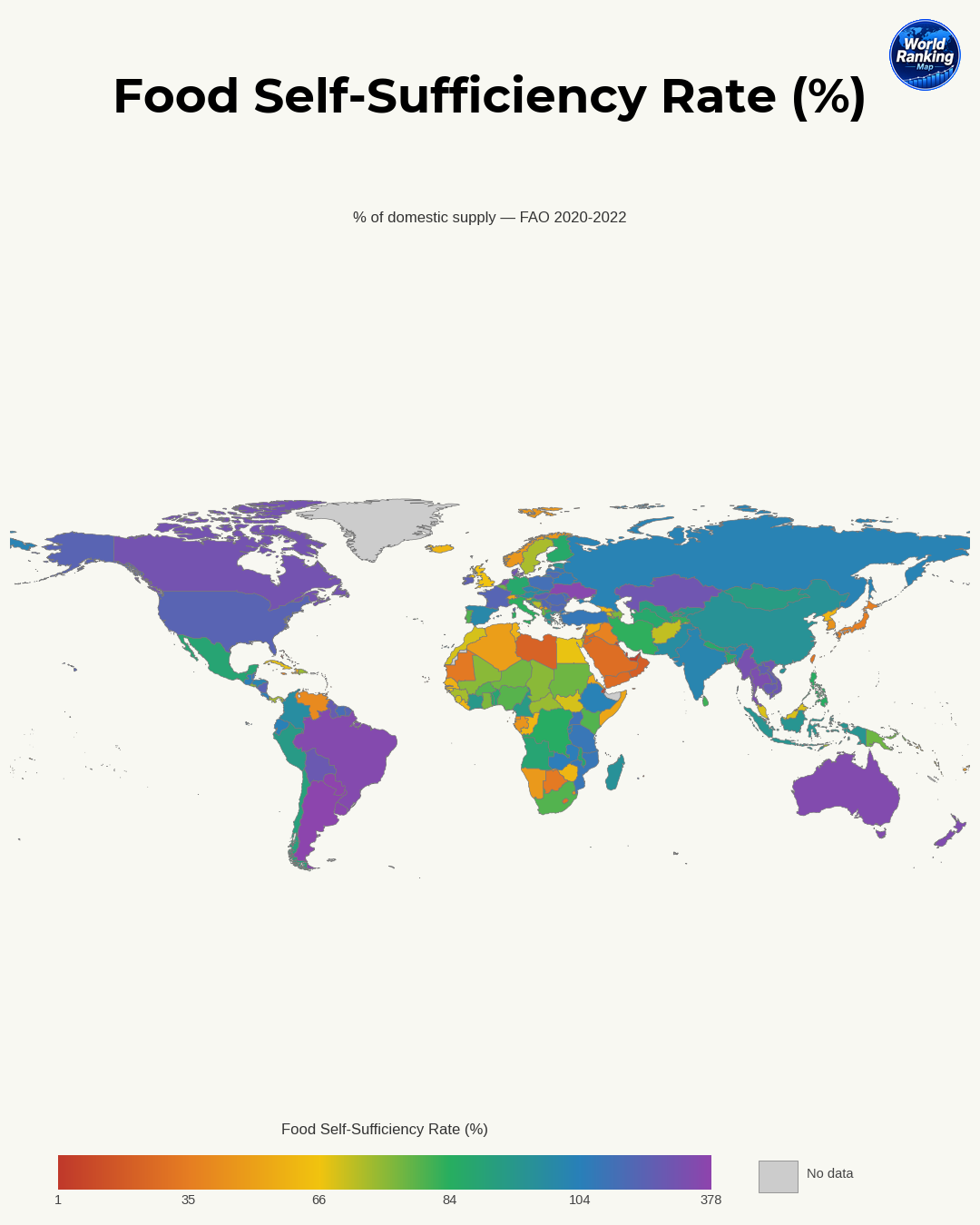
Asia is the continent where most of the world’s population is concentrated, making it the most complex region when discussing food self-sufficiency. Overall, many countries have large-scale agricultural production capacity, but at the same time population is so large that demand pressure is very high. In other words, production volumes are enormous, but consumption is just as large, so the self-sufficiency structure is always under tension.
One of Asia’s biggest characteristics is limited arable land. Many parts of East and South Asia have high population density and rapid urbanization, making it difficult to expand farmland. Because per-capita farmland is limited, increasing productivity through irrigation, intensive farming, improved varieties, and multiple cropping becomes important. However, these methods can be vulnerable to water shortages, soil fatigue, and rising energy costs.
In terms of production structure, rice-centered agriculture remains dominant. Many countries in Southeast and South Asia have strong rice production bases, giving them high rice self-sufficiency or even export capacity. By contrast, items such as wheat, corn, and soybeans vary widely by country. In particular, countries with rising meat consumption tend to become more dependent on imports of feed grain and soybean meal.
Country-by-country differences are also very large.
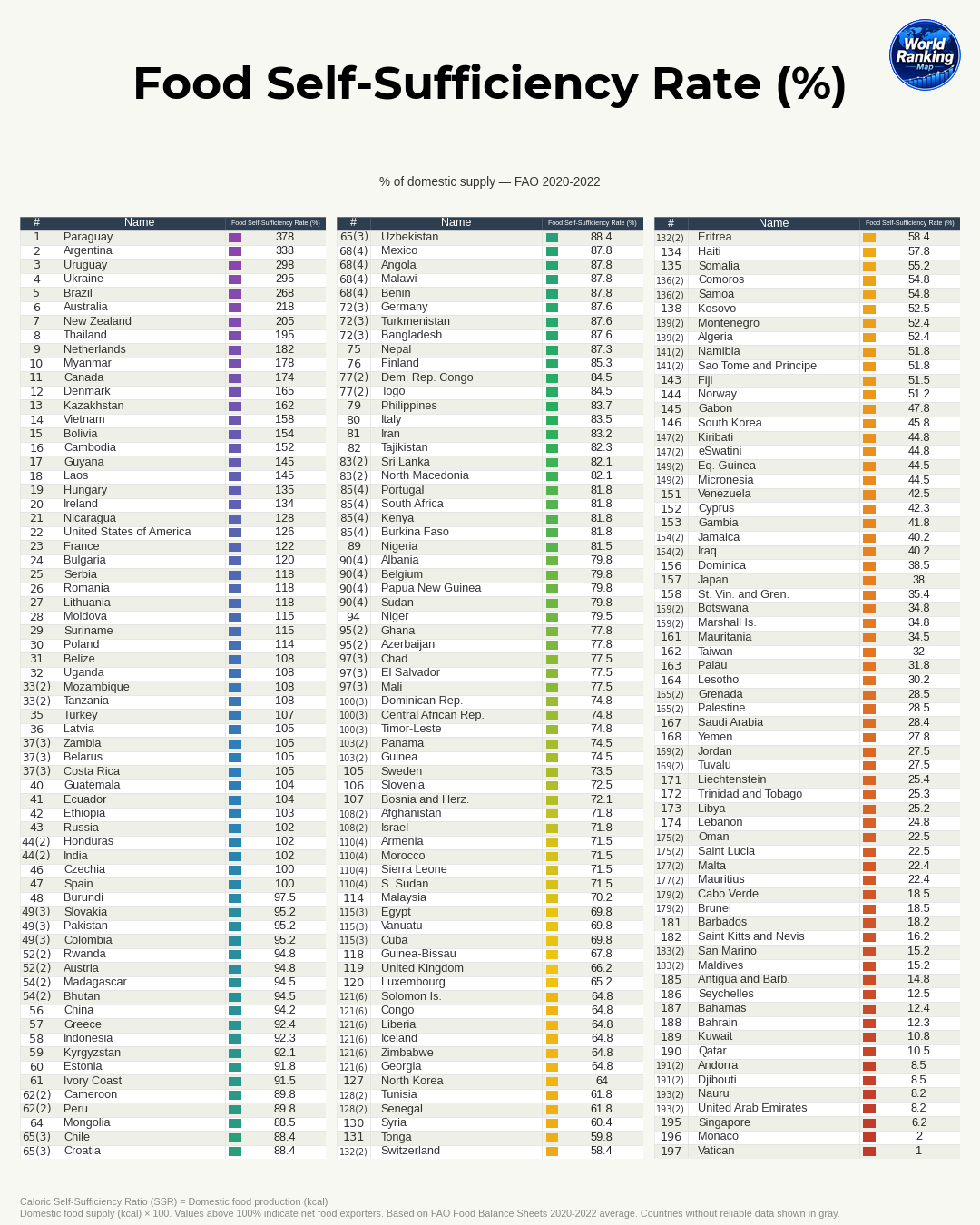
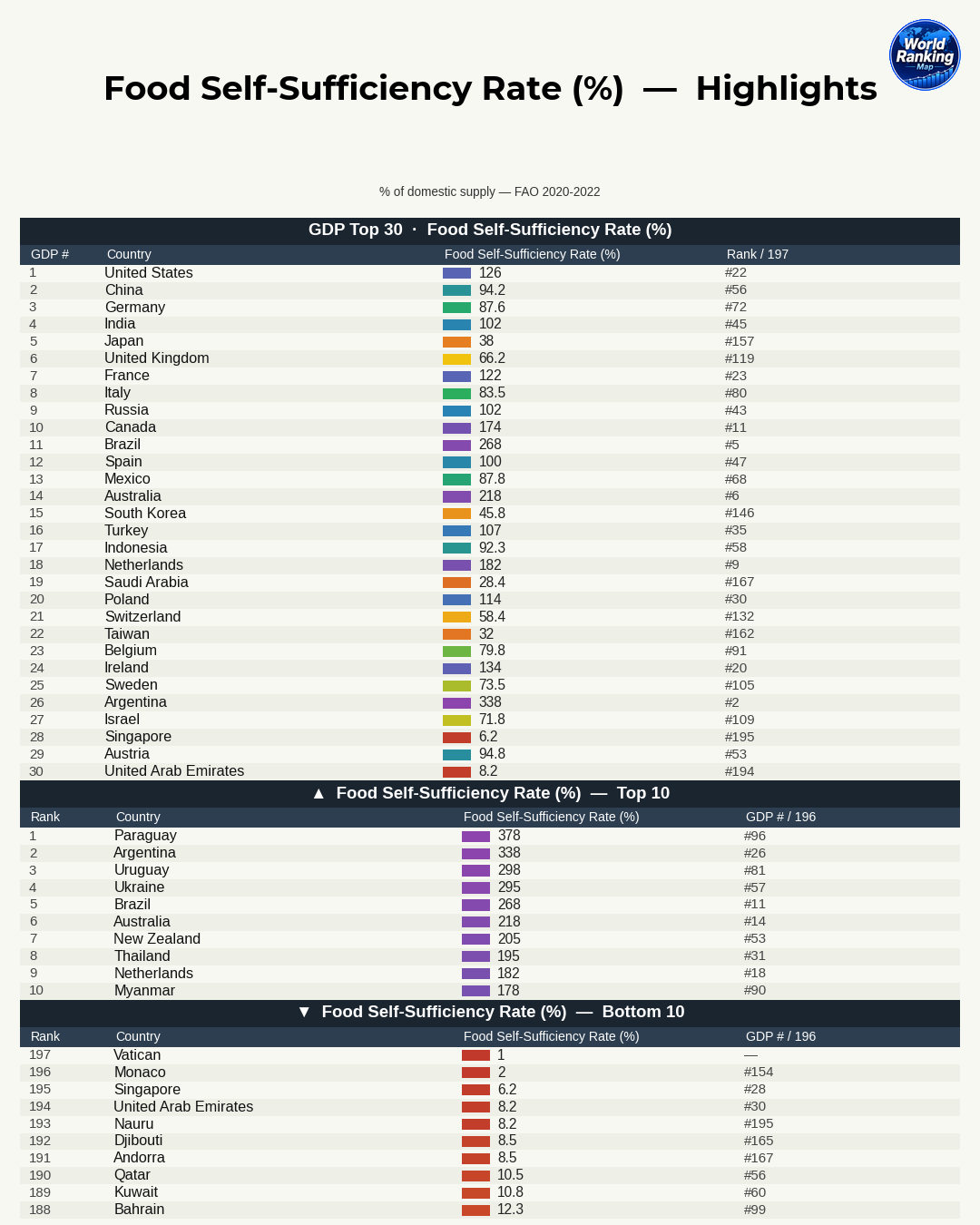
- China is a massive agricultural producer, but because of its huge population, its self-sufficiency structure differs by item.
- India has a strong production base for rice and wheat, but faces regional climate risks and distribution problems.
- Countries such as Japan, South Korea, and Singapore have relatively high import dependence due to land constraints and high urbanization.
- Thailand and Vietnam stand out for their rice export competitiveness.
- Middle Eastern Asian countries often face structural limits on grain self-sufficiency because of water scarcity.
Asia is therefore both a “production continent” and an “import continent.” As population growth, rising incomes, and greater meat consumption continue, broader food security that includes feed, edible oils, fertilizer, and water is becoming more important than simple grain self-sufficiency.
Europe: The Combination of High-Productivity Agriculture and Intra-Regional Trade
Europe’s food self-sufficiency structure can be explained by the combination of high agricultural productivity and intra-regional trade networks. Many countries in Western and Central Europe have maintained relatively high productivity based on mechanization, improved varieties, agricultural R&D, and storage and transport infrastructure. Yields per unit area are high, and value chains linking livestock and processing industries are well developed.
The European Union’s Common Agricultural Policy (CAP) and common market also play a major role. Subsidies, price stabilization mechanisms, rural support, environmental regulations, and tariff-free intra-regional trade connect production and consumption in a complementary way among member states. Some countries are strong in grains, while others specialize in dairy, meat, or horticultural crops. As a result, even if a particular country has low self-sufficiency in certain items, a relatively stable supply system exists at the European level.
A key feature of Europe is that self-sufficiency should be viewed not only as domestic production but as a regional integration system. For example, Northern and Western Europe have strong dairy and livestock competitiveness, while France and parts of Eastern Europe have strong grain production bases. Southern Europe has strengths in fruits, vegetables, and olive oil. Thanks to this structure, Europe can adjust many item-level imbalances through trade.
Of course, there are limitations. European agriculture is heavily affected by energy prices, fertilizer costs, environmental regulations, and climate change. In particular, droughts, heat waves, and changing precipitation patterns are increasing volatility in wheat and corn production. A high share of livestock production also brings feed import dependence and environmental burdens. Even so, Europe is regarded as one of the world’s more stable food supply regions thanks to its four pillars of productivity, institutions, logistics, and the common market.
Africa: The Duality of Agricultural Potential and Low Stability
Africa is a continent where potential and vulnerability surrounding food self-sufficiency are both very large. Vast arable land, a young population, and diverse climate zones point to long-term agricultural growth potential. In some areas, production of corn, cassava, sorghum, millet, rice, and horticultural crops is rising rapidly, and the agri-food market is expanding alongside urbanization.
In reality, however, low stability is a major problem. One of the biggest factors is climate risk. Because rain-fed agriculture is widespread, droughts, floods, pests, and desertification have a major impact. When a climate shock hits, production can drop sharply, quickly leading to price instability and reduced access to food.
Another constraint is insufficient infrastructure. If irrigation systems, storage facilities, cold-chain distribution, roads, ports, and electricity supply are inadequate, even rising production cannot be reliably connected to markets. Large post-harvest losses are also a barrier to improving self-sufficiency. In addition, low fertilizer use, low mechanization, limited access to finance, and unstable land tenure systems make productivity gains difficult.
Still, Africa cannot simply be viewed as a low-self-sufficiency continent. Regional differences are very large.
- North Africa tends to rely heavily on grain imports because of water scarcity.
- Sub-Saharan Africa has strong production potential but severe climate and infrastructure constraints.
- Some parts of East Africa are expanding their food production base alongside commercial crops such as horticulture, tea, and coffee.
- West Africa is continuing efforts to expand production in response to rising demand for rice and cassava.
The key issue for Africa is not absolute production volume, but whether it can build stable production and distribution systems. If irrigation expansion, seed improvement, fertilizer access, and regional trade are supported, there is significant room to raise the self-sufficiency base over the medium to long term.
North America, South America, and Oceania: Common Features and Differences of Export-Oriented Agricultural Continents
North America, South America, and Oceania are generally regions with a strong export-oriented agriculture character. They share large farmland areas, relatively low population density, large-scale mechanized farming, and strong links to international markets. As a result, many countries produce more than they consume domestically and account for a major share of the global grain, meat, and oilseed markets.
North America is characterized by highly advanced commercial agriculture. The United States and Canada show high productivity across a wide range of items, including wheat, corn, soybeans, meat, and dairy, and are central pillars of the global food supply chain. Advanced farm machinery, precision agriculture, large-scale storage and transport infrastructure, and futures markets and financial systems are integrated, making production and exports highly systematic. However, droughts, energy prices, trade disputes, and changes in biofuel policy can affect supply structures.
South America has become much more prominent in global agriculture over the past few decades. Brazil and Argentina are highly competitive in soybeans, corn, beef, poultry, and sugar. Some countries also account for large shares of coffee, fruit, soybean meal, and edible oils. South America’s strengths lie in land and climate conditions and an export-oriented production structure, but it also faces gaps in logistics infrastructure, exchange-rate volatility, deforestation issues, and climate change risks.
Oceania, especially Australia and New Zealand, has a very large agricultural production and export share relative to its population size. Australia is strong in wheat, barley, beef, and wool, while New Zealand has world-class competitiveness in dairy and livestock. Because export shares are higher than domestic consumption, self-sufficiency itself is very high, but the region is sensitive to rainfall variability, drought, and international price fluctuations.
The common features and differences among the three continents can be summarized as follows.
- Common features: Large-scale agriculture, high mechanization, dependence on international markets, export competitiveness
- North America’s strength: High integration of technology, finance, and logistics
- South America’s strength: Rapid production expansion and land resources
- Oceania’s strength: Overwhelming export capacity relative to population
- Common risks: Climate change, maritime logistics disruptions, sharp international price swings, tighter environmental regulations
These continents occupy a special place in the global food system not only because their self-sufficiency is high, but because they are suppliers that also affect the self-sufficiency of other continents.
Structural Variables That Determine Food Self-Sufficiency
Food self-sufficiency is not determined by short-term production alone. In the long run, several structural variables interact. The first is climate change. Rising average temperatures, unstable rainfall, heat waves, droughts, floods, and the spread of pests and diseases all undermine both yields and production stability. Even with the same farmland and the same technology, a larger climate shock can easily reduce self-sufficiency.
Water scarcity is another key variable. Regions that rely on irrigated agriculture are vulnerable to groundwater depletion and reduced river flows. When water is scarce, the production of major crops such as rice, wheat, and vegetables is directly affected. In particular, agriculture in dry regions and near large cities also faces competition over water allocation.
Differences in agricultural technology create major continental disparities. High-yield varieties, precision agriculture, drones, satellite data, smart irrigation, storage technology, cold-chain distribution, and biotechnology all change productivity and loss rates at the same time. It is not simply a matter of having more land; what matters is how efficiently technology is applied.
In addition, trade policy changes the meaning of self-sufficiency. Tariffs, export restrictions, import controls, free trade agreements, and sanctions all alter food flows and price dynamics. Imports may be efficient in normal times, but in a crisis, protectionism and export controls can worsen supply instability.
Fertilizer and energy prices are also important. Modern agriculture depends heavily on natural-gas-based fertilizer, fuel, electricity, and transportation costs. When fertilizer prices surge, production costs rise, and farmers in low-income countries may reduce input use. This can then lead to lower yields.
Other important variables include the following.
- Soil health and desertification
- Aging agricultural labor force and labor shortages
- Loss of farmland due to urbanization
- Exchange rates and external debt burdens
- War, conflict, and political instability
- Storage and logistics infrastructure levels
Ultimately, food self-sufficiency is not just an agricultural issue, but a comprehensive outcome shaped by climate, energy, technology, trade, finance, and demographic structure.
Outlook: ‘Food Resilience’ Matters More Than Self-Sufficiency
Going forward, food resilience is likely to become a more important concept than food self-sufficiency itself. Even if self-sufficiency is high, the food system can still be shaken by drought in a particular region, fertilizer supply disruptions, port shutdowns, or power shortages. Conversely, even if self-sufficiency is low, a country can better withstand crises if it has diversified import sources, sufficient reserves, and strong logistics and diplomatic capacity.
Food resilience consists of several elements.
- Supply chain stability: How robust the transport, processing, and storage systems are from production areas to consumers
- Stockpiling capacity: Whether essential grains and foods can be stored to last for a certain period
- Import diversification: Whether dependence on a single country or shipping route has been reduced
- Maintaining domestic production capacity: Whether at least strategic items can still be produced domestically, even without full self-sufficiency
- Sustainability: Whether long-term production can be maintained without damaging soil, water, and ecosystems
- Social accessibility: The existence of food is one thing; whether people can actually afford it is another
The future direction will differ somewhat by continent. In Asia, stockpiling, technological innovation, and import diversification will be important for managing high population density and import dependence. In Europe, balancing environmental regulation with productivity and maintaining regional cooperation will be key. In Africa, productivity gains and infrastructure expansion are likely to be the starting point for resilience. In North America, South America, and Oceania, climate-change adaptation and sustainable export systems will become increasingly important as these regions serve as global suppliers.
In conclusion, future food competitiveness will not be determined solely by “how much is produced.” How stably it can be procured, how well it can withstand shocks, and how sustainably it can be maintained are becoming more important. Food self-sufficiency remains a useful starting point, but in the years ahead, the world will pay closer attention to the resilience that lies beyond the number.