Current Status and Gaps in Higher Education Attainment by Continent
What Is Higher Education Attainment?
Higher education attainment generally refers to the share of the population that has completed a certain level of education beyond secondary school, such as junior college, university, or graduate school. In international statistics, it is usually measured as the proportion of adults aged 25 and over who have earned a higher education degree, or the completion rate of higher education programs within a specific age group. Because countries may differ in whether they include associate degrees, bachelor’s degrees, master’s degrees, and doctoral degrees, it is important to first check the definition being used.
There are three main measurement standards.
- Attainment rate based on highest educational level: the share of adults with a higher education degree
- Age-group attainment rate: comparison of educational levels across specific cohorts such as ages 25–34 or 25–64
- Indicators related to enrollment and graduation rates: supplementary indicators that capture both access to higher education and actual completion outcomes
There are several points to keep in mind in international comparisons. First, there are major differences in education system structures. In some countries, the boundary between vocational education and higher education is relatively flexible, while in others the university-centered system is stronger. Second, statistical methods and survey timing may differ. Third, a high higher education attainment rate does not necessarily mean that educational quality or labor market outcomes are equally high. Therefore, attainment is an important indicator, but it should be interpreted together with access, completion rates, field-of-study structure, and employment outcomes.
Overall Trends in Higher Education Attainment by Continent
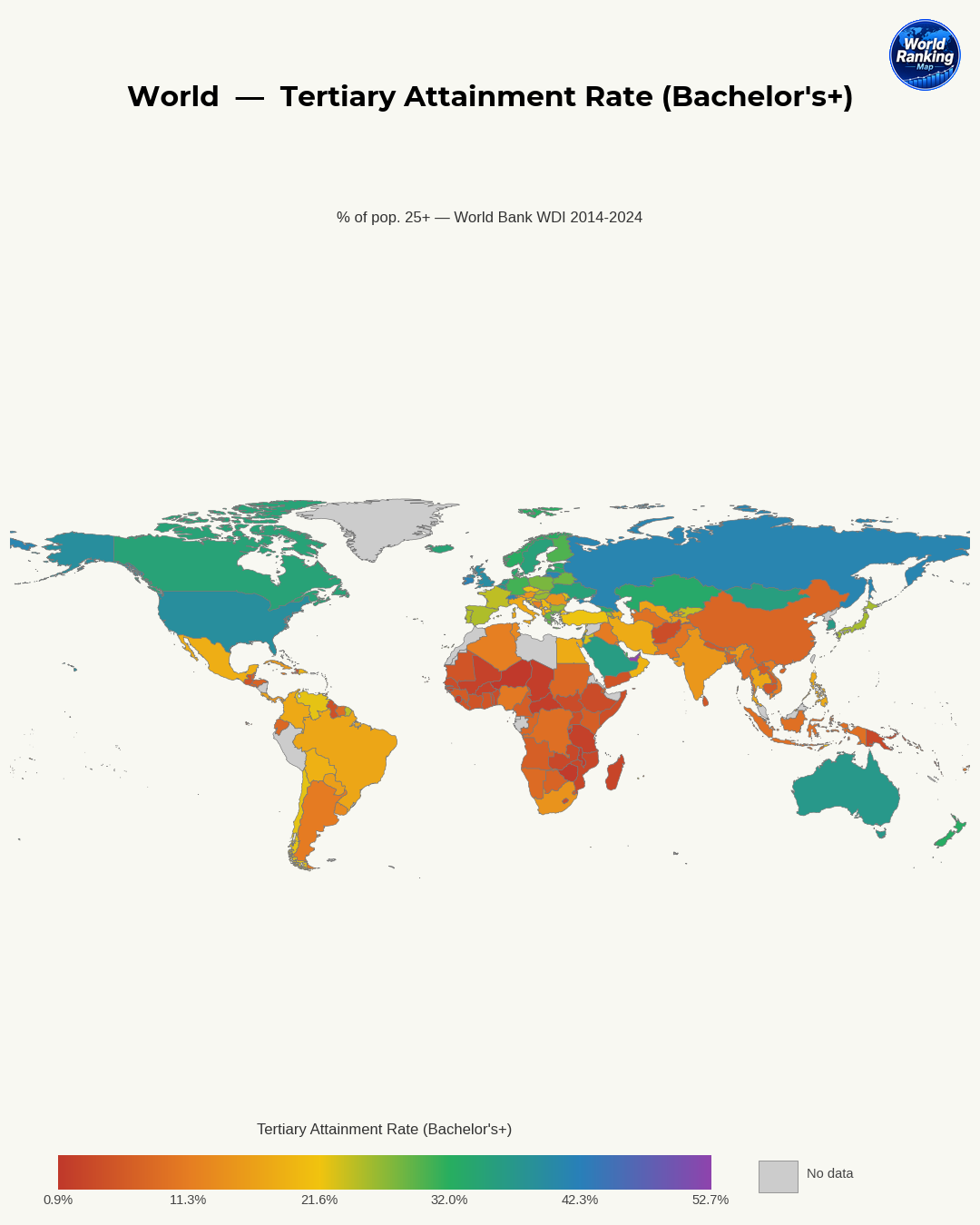
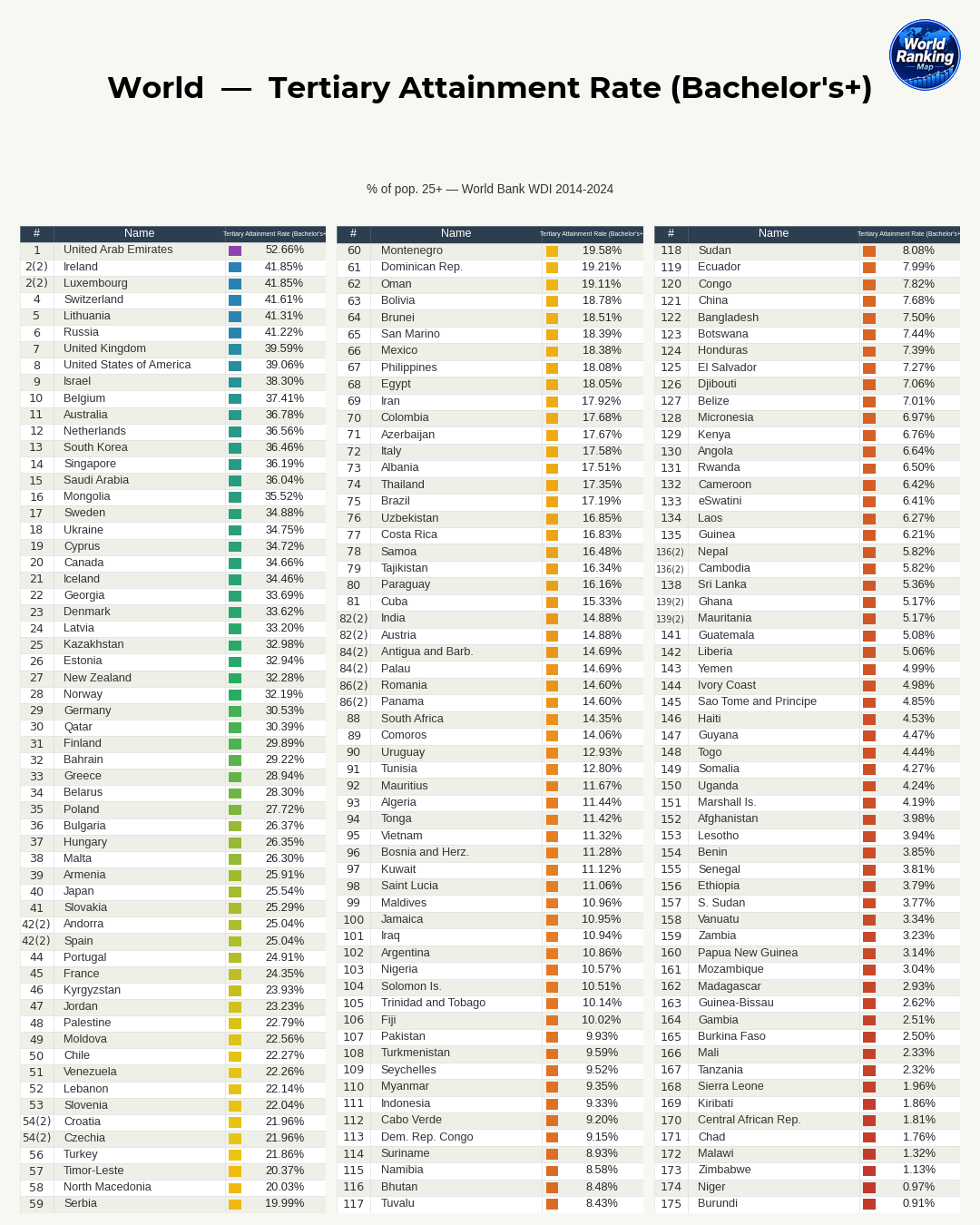
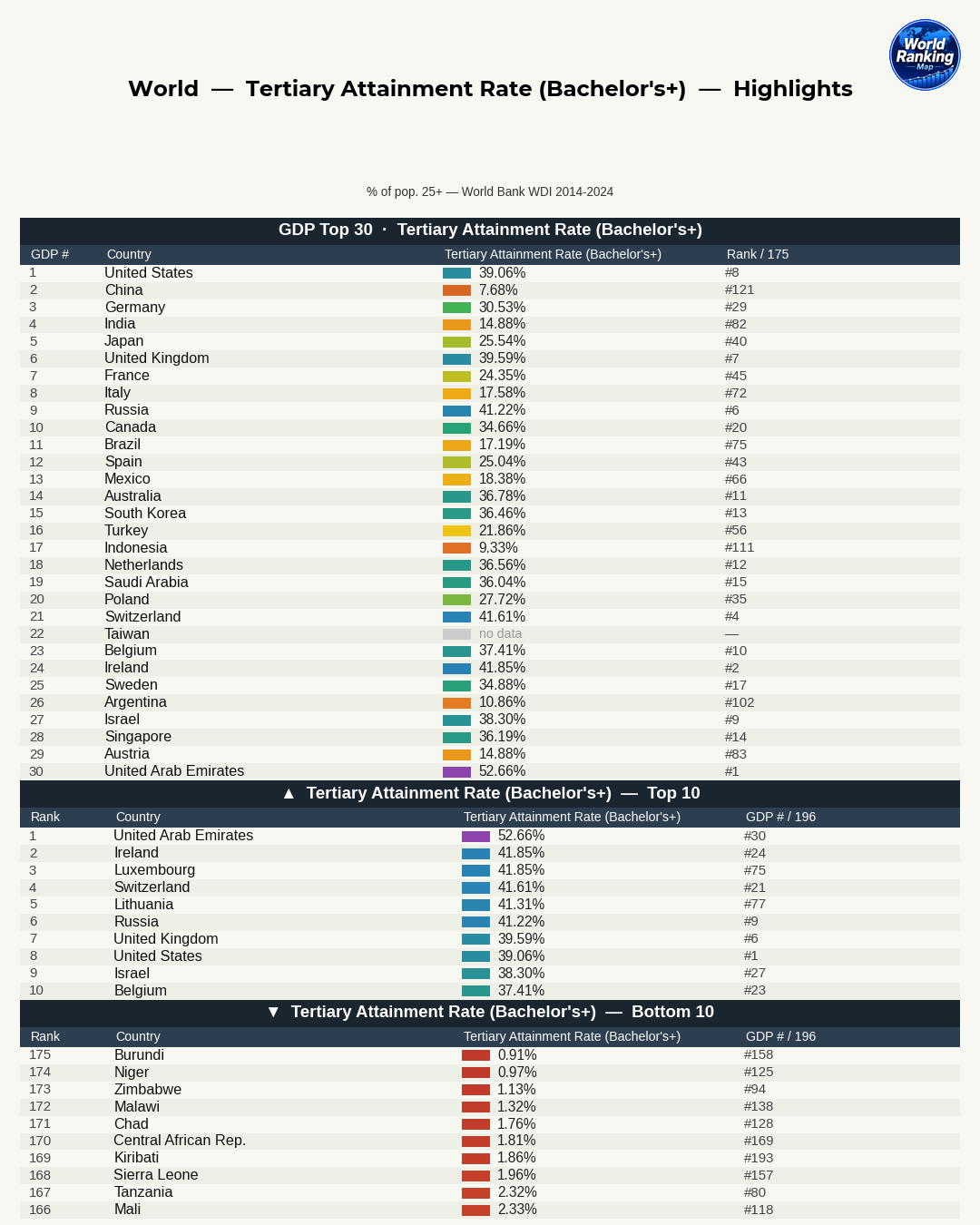
Globally, higher education attainment has been rising over the long term. However, levels and rates of increase vary considerably by continent. In general, North America and Europe are at high levels, Oceania and some East Asian countries are catching up rapidly, South America is improving from a middle level, and Africa remains the lowest but is gradually expanding.
Asia has the world’s largest population, so internal variation is also very large. While East Asia and some West Asian countries show high attainment rates, South Asia and low-income countries often remain at lower levels. Overall, however, the trend is clearly upward, driven by expanded university capacity and the growth of the middle class.
Europe maintains high higher education attainment, especially in Western and Northern Europe. In Central and Eastern Europe as well, educational participation has steadily expanded since the transition away from socialist systems, raising average levels. Among younger generations, the share with higher education is often higher than among older generations, so the rise continues through generational replacement.
North America has long shown a high level of higher education participation worldwide. University attendance became widespread relatively early, and the economic returns to earning a degree are comparatively clear. Recently, however, tuition burdens and student loan issues have also been cited as constraints on further expansion.
South America has improved its attainment rate over the past several decades through the expansion of public universities, the introduction of scholarship systems, and the growth of private higher education. Still, differences in fiscal capacity and educational quality across countries remain large.
Africa remains at the lowest overall level, but the number of people with higher education is increasing, especially in urban areas and in some middle-income countries. As the gains from expanded basic education accumulate, the region has strong long-term potential for growth.
Oceania is led by Australia and New Zealand, which have high attainment rates. By contrast, Pacific island countries face a different situation due to small population sizes, geographic constraints, and limited educational infrastructure. In other words, even if the continental average looks high, the internal structure is not simple.
Europe and North America: The Foundations of High Attainment
The high higher education attainment in Europe and North America is not simply the result of having many universities, but of institutional foundations built up over a long period. One of the most important factors is investment in public education. In particular, many European countries have kept tuition low or nearly free and have reduced socioeconomic barriers through student support systems.
Another key factor is access to higher education. A wide range of public universities, universities of applied sciences, community colleges, and vocationally linked higher education institutions are available by region, so students are not dependent on a single pathway. This makes it possible to attain higher education even without entering a traditional research university.
Labor market structure also has a major influence. In Europe and North America, a degree functions as a basic qualification for many professional, office, and public-sector jobs. As a result, individuals strongly perceive higher education attainment as advantageous in terms of wages, job security, and career mobility. This structure continuously sustains demand for higher education.
In addition, the following factors support high attainment rates.
- Student support systems: scholarships, living allowances, student loans, counseling services
- Flexible learning pathways: transfer options, adult learning, part-time enrollment, retraining programs
- Expanded participation of women in education: in many countries, women’s higher education attainment exceeds men’s
- Data-driven policy: dropout management, tracking employment outcomes, policies to reduce regional disparities
Of course, the two regions are not identical. Europe tends to be more publicly oriented, while North America has stronger market-based elements and institutional diversity. Even so, they share the common feature that the mass expansion of higher education was established long ago.
Asia and Oceania: Rapid Expansion and Gaps Between Countries
Asia is one of the regions where higher education has expanded most rapidly over the past several decades. Economic growth, urbanization, the expansion of the middle class, and rising educational expectations among parents have combined to sharply increase demand for university education. Governments have also increased the number of universities and expanded admissions quotas, which has driven attainment rates upward quickly.
In particular, some East Asian countries record higher education attainment levels that are among the highest in the world. By contrast, South Asia and parts of Southeast Asia may have insufficient educational infrastructure relative to population size, or household financial burdens that limit the pace of improvement. In other words, Asia is characterized by rapid growth alongside very large internal disparities.
Oceania shows a similar dual structure. Australia and New Zealand maintain high attainment rates thanks to strong international student recruitment, adult retraining, and well-developed links between vocational education and universities. However, Pacific island countries are geographically dispersed and have few higher education options, making access a major challenge. Distance education can be an alternative, but digital infrastructure and language environments can still be limiting factors.
The main characteristics of this region are as follows.
- Government-led expansion of enrollment capacity and establishment of new universities
- Rising social costs due to intense private tutoring and entrance exam competition
- Income gaps between countries translating into gaps in educational opportunity
- Dependence on overseas study and foreign degrees as an important pathway in some countries
Ultimately, while Asia and Oceania show a clear upward trend in average terms, balancing quantitative expansion with quality management remains an important challenge at the country level.
South America and Africa: Improvement Trends and Structural Challenges
South America is a region where the mass expansion of higher education has steadily progressed. Increased public investment, scholarships for low-income students, the establishment of regional universities, and the growth of private universities have all contributed to higher attainment rates. In some countries, the share of first-generation college students has risen sharply, strengthening higher education’s role as a pathway to social mobility.
However, structural challenges remain despite the improvement trend. Dropout rates are high, educational conditions differ greatly between prestigious urban universities and regional institutions, and there are clear gaps in college access by household income. In particular, indirect costs such as transportation, housing, and learning devices affect attainment rates significantly, not just tuition.
Africa faces an even more complex set of challenges. As access to primary and secondary education expands, demand for higher education is rising rapidly, but in many cases the university infrastructure and funding needed to absorb that demand are insufficient. Shortages of classrooms, dormitories, laboratories, and faculty are common problems. Political and economic instability, youth unemployment, regional conflict, and limited access to electricity and the internet also weaken educational continuity.
Even so, there are clear positive developments.
- Expanded capacity through the growth of public universities and private institutions
- Scholarship and research support through international organizations and overseas partnerships
- Online and blended learning easing some geographic constraints
- Policies to expand women’s education strengthening the long-term foundation
For both South America and Africa, the key is not simply increasing the number of entrants, but improving the sustainability that leads to actual graduation and degree completion.
Differences by Gender, Age, and Level of Urbanization
Looking only at continental averages can reveal the broad trend, but actual higher education attainment varies significantly by gender, age, and place of residence. A common pattern in many regions today is that younger generations have higher attainment rates than older generations. This reflects the fact that higher education has become more widespread over time.
In terms of gender, many countries in Europe, North America, and Oceania show a pronounced pattern in which women’s higher education attainment exceeds men’s. Similar trends are also expanding in Asia and South America. By contrast, in some African and South Asian countries, women’s attainment remains lower due to early marriage, domestic labor burdens, cultural constraints, and safety concerns.
By age, the 25–34 group generally reflects the most recent gains in educational expansion. In contrast, attainment rates are often relatively low among those aged 55 and older. This gap goes beyond a simple generational difference and suggests that labor markets and political and social structures may become increasingly centered on a more highly educated population in the future.
Urbanization is also very important. Large cities and capital regions tend to have higher attainment rates because they offer denser university networks, better access to information, transportation, private tutoring, and job opportunities. By contrast, rural and peripheral areas often face disadvantages such as the following.
- A lack of nearby higher education institutions
- Higher living and commuting costs
- Weak digital infrastructure
- Family pressure to enter the labor force early
Therefore, when interpreting continental attainment averages, it is necessary to also ask who is actually completing higher education. A rise in the average does not necessarily mean greater equity.
Key Factors Affecting Higher Education Attainment
Higher education attainment is determined by a combination of structural factors. The most basic variable is income level. The stronger a country’s economy, the easier it is to secure funding for school facilities, faculty, and student support, and households are also more able to afford education costs.
Another important factor is government policy. Tuition regulation, free education, scholarships, support for regional universities, links between vocational education and universities, and dropout prevention programs all directly affect attainment rates. Even countries with similar income levels can show large differences in outcomes depending on policy design.
Tuition burden is also a key factor. If not only tuition but also housing, textbooks, transportation, and opportunity costs are high, low-income students are less likely to complete higher education. In countries where many students enroll but do not graduate, cost burden is a particularly important explanatory variable.
Recently, online education and digital learning have also become more influential. Distance learning, blended classes, and credit-bank systems provide new opportunities for adult learners and people living in rural areas. However, their effectiveness may be limited unless internet access, learning management capacity, and degree recognition systems are in place.
Population structure is another factor that cannot be overlooked. Countries with rapidly growing youth populations see demand for higher education rise quickly, but if supply cannot keep up, attainment growth slows. By contrast, countries with low birth rates and active adult retraining are more able to shift toward quality-centered policies.
The key factors can be summarized as follows.
- National income and fiscal capacity
- Government investment in education and policy design
- Household burden of tuition and living costs
- Labor market demand for degrees
- Online education and technological infrastructure
- Urbanization and balanced regional development
- Gender norms and sociocultural environment
- Youth population size and generational structure
Future Outlook and Policy Implications
Global higher education attainment is likely to continue rising in the future. The expansion of knowledge-based industries, the need to respond to automation, and growing demand for professional skills are all increasing the importance of degrees and job-related competencies. In particular, Asia, South America, and Africa still have significant room for expansion, and the increase may be especially strong among younger generations.
However, quantitative expansion alone will not be enough. The focus of future policy is likely to shift from expanding access to ensuring actual completion and outcomes. In other words, it will become more important not only who enters university, but who graduates, what skills they acquire, and how they connect to the labor market.
The policy directions for reducing continental gaps are relatively clear.
- Strengthen financial support for low-income groups
- Expand regional hub universities and remote education infrastructure
- Improve access for women and rural youth
- Strengthen links between vocational education and university education
- Build counseling and learning support systems to prevent dropout
- Improve quality assurance and the labor-market relevance of degrees
For Europe and North America, it is important to maintain high attainment while addressing tuition burdens, field-of-study mismatch, and youth debt problems. Asia and Oceania need to reduce gaps between countries and differences in educational quality amid rapid expansion. In South America and Africa, expanding access together with fiscal stability, infrastructure development, and greater equity will be the key challenge.
Ultimately, higher education attainment is not just an education statistic; it is an indicator of a society’s opportunity structure, welfare level, stage of economic development, and future competitiveness. Going forward, more important than continental rankings will be how inclusively and sustainably each region supports more people in completing their studies.