Regional Trends in Per Capita Meat Consumption
What Is Per Capita Meat Consumption?
Per capita meat consumption refers to the average amount of meat consumed by one person in a country or region over the course of a year. It is usually expressed in kilograms (kg/person/year), and comparisons are made by adding up consumption of major livestock categories such as beef, pork, poultry, and lamb. In international statistics, rather than directly measuring what each individual actually eats, it is often estimated on a “supply basis” by adding domestic production and imports, then subtracting exports and some non-food uses.
Because of this, statistical consumption figures may include some losses from households, restaurants, and distribution processes, and collection methods can differ from country to country. With those limitations in mind, this article looks at the current state of per capita meat consumption, focusing on global trends, regional differences, and the factors behind them.
The Overall Trend in Global Per Capita Meat Consumption
Global per capita meat consumption has shown a long-term upward trend. As industrialization and urbanization have advanced, incomes have risen, and refrigeration and distribution infrastructure have expanded, meat has become more accessible in many regions. In recent years, the global average has generally been cited at around the mid-to-high 30s to about 40 kg per year, a level that is significantly higher than it was decades ago.
Looking at the long-term trend, the increase has not been uniform across all regions. High-income regions such as North America and Oceania have already reached high consumption levels and therefore show relatively stagnant or only modest changes, while Asia and parts of Latin America have grown rapidly alongside economic expansion. By contrast, many African countries have fast population growth and significant income constraints, so even if total consumption rises, per capita consumption often increases only modestly.
More recently, concerns about health, climate change, animal welfare, and the expansion of the alternative protein market have led some developed countries to reduce red meat consumption and shift toward poultry or plant-based alternatives. In other words, while the global average is still rising or holding near a peak, the internal composition of that consumption is becoming increasingly diverse.
Comparing Regional Per Capita Meat Consumption
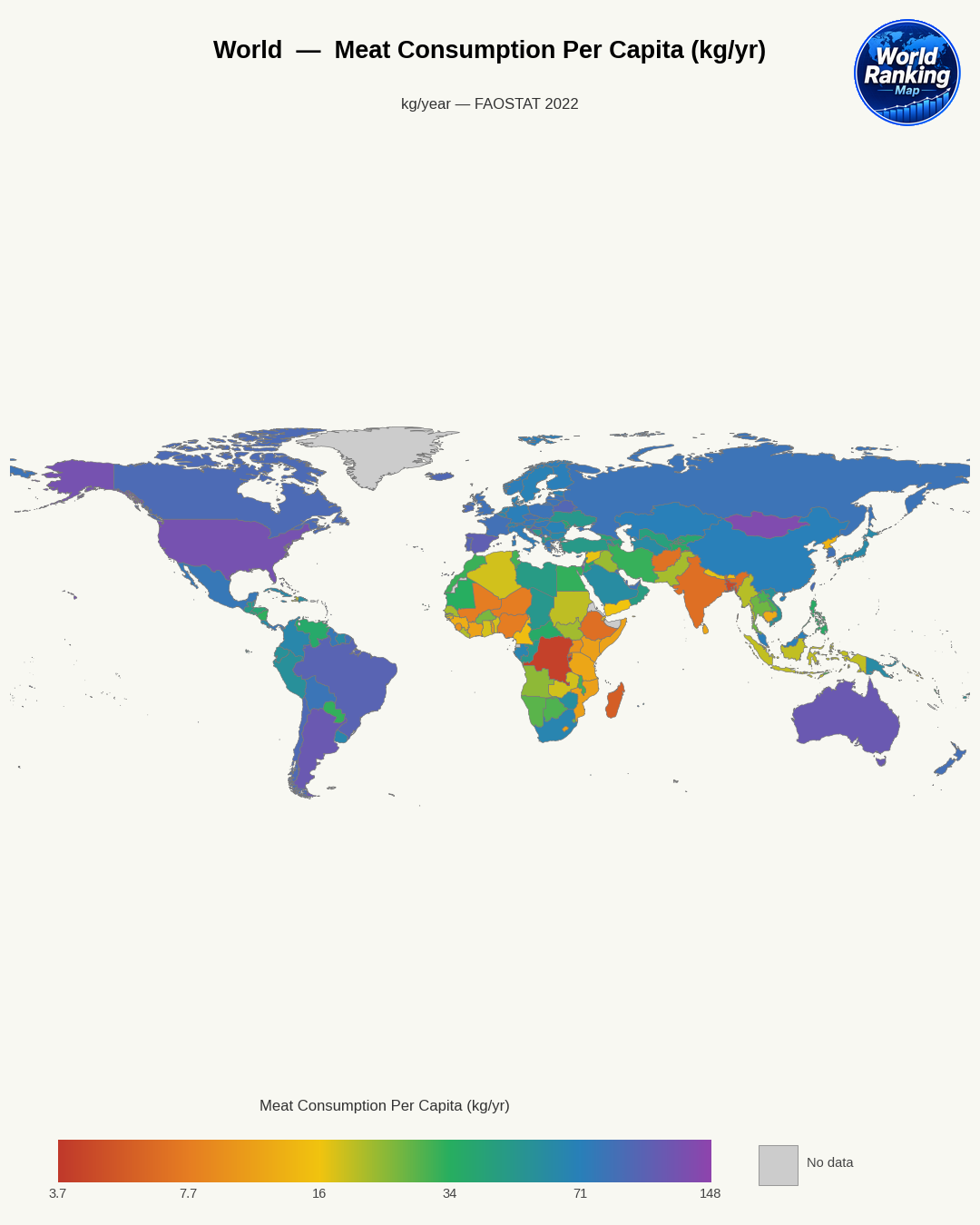
By region, North America is among the highest meat-consuming regions in the world. The United States and Canada both consume large amounts of beef, pork, and chicken, supported by a strong dining-out culture, large-scale livestock industries, and high purchasing power. Although the composition of consumption is changing due to health and environmental concerns, overall levels remain high.
Europe is also a high-consumption region overall. However, there are differences between Western and Eastern Europe, and between Northern and Southern Europe. Many European countries consume a large share of pork and poultry, and some have traditionally high processed meat consumption. At the same time, as sustainability discourse has grown stronger, some countries have shown a relatively clear move toward reducing total meat intake.
Asia shows very wide internal disparities. Some high-income countries in East Asia and China are near or above the global average, while many countries in South Asia remain far lower. Because Asia has such a large population, it also has a major impact on the global meat market. In particular, the expansion of the middle class and urbanization are key drivers of rising poultry and pork consumption.
South America is traditionally regarded as a region with high meat consumption. Countries such as Brazil, Argentina, and Uruguay have strong beef and poultry consumption, and the development of livestock and export industries also affects domestic demand. However, because economic volatility is high from country to country, during downturns consumption patterns may shift from beef to cheaper poultry.
Africa has the lowest average consumption levels. Income constraints, limited cold-chain infrastructure, and high food prices are the main reasons. That said, North Africa and parts of Southern Africa are relatively higher, and poultry-centered consumption is increasing in some areas. Overall, per capita consumption growth remains modest compared with population growth.
Oceania has a small population, but very high per capita meat consumption. Australia and New Zealand have strong livestock sectors and a clear tradition of beef and lamb consumption. Recently, however, a shift toward greater poultry consumption has also been observed due to health and price factors.
Key Factors Behind Regional Differences
The first factor explaining regional gaps is income level. In general, as household income rises, meat consumption tends to increase. In low-income countries especially, meat consumption can rise quickly as incomes improve, while in high-income countries that have already reached high levels, growth tends to slow or plateau.
The second is food culture and tradition. For example, beef-centered food culture in South America, pork consumption in parts of East Asia, and diverse meat-cooking traditions in the Mediterranean are all tied to long histories. It is also important that meat is not just a source of nutrition, but part of social symbolism and everyday diets.
The third is urbanization and distribution infrastructure. As urbanization progresses, cold-chain logistics, large supermarkets, the restaurant industry, and processed food markets develop, making meat more accessible. In particular, products like chicken, which are easier to produce and distribute at scale, are strongly affected by urbanization.
The fourth is religion and social norms. In Muslim-majority regions, pork consumption is restricted, and in Hindu cultural contexts, beef consumption tends to be low. These norms are not merely personal preferences; they also affect national market structures and production systems.
The fifth is livestock industry structure and prices. Feed costs, land use, import dependence, government subsidies, and trade policy all influence consumption levels. For example, chicken often becomes the fastest-growing meat in many regions because it has a short production cycle and high efficiency, making it relatively affordable.
- Income growth: Strong consumption expansion effect in low-income countries
- Culture and tradition: Shapes preferred meats and cooking methods
- Religious norms: Structurally limit consumption of certain meats
- Price competitiveness: A key reason poultry has expanded
- Distribution infrastructure: Urbanization encourages higher consumption
Regional Differences in Consumption by Meat Type
Meat consumption differs greatly not only in total volume, but also in which types of meat are eaten most. Beef has a relatively large share in North America, South America, and Oceania. In regions where pasture-based livestock farming is possible, or in countries with strong beef production, price accessibility is relatively good and traditional food culture supports it.
Pork is strong in Europe and East Asia. China accounts for a very large share of the global pork market, and many European countries also have high pork consumption, including processed meat culture such as ham and sausages. However, in Muslim-majority regions, pork consumption is very low or virtually nonexistent for religious reasons.
Poultry, especially chicken, is becoming increasingly important in almost every region. This is because it is efficient to produce, relatively inexpensive, and subject to fewer religious restrictions. The perception that it is less burdensome than red meat from a health perspective also contributes to its growth. In many countries across Asia, Africa, and Latin America, chicken has been the fastest-growing meat category.
Lamb and goat meat are not a major share of global consumption, but they play an important role in parts of the Middle East, Central Asia, North Africa, and Oceania. These products are closely tied to climate, grazing conditions, and traditional culinary culture.
In summary, regional patterns generally look like this:
- North America: Strong in beef and poultry
- Europe: Pork and poultry-centered, with large country-by-country differences
- Asia: Pork in East Asia, low total consumption in South Asia, poultry expanding overall
- South America: Strong beef tradition, but poultry also significant
- Africa: Low total volume, with poultry gaining share
- Oceania: Beef and lamb traditions, with poultry rising recently
Internal Gaps Seen Through Country Rankings
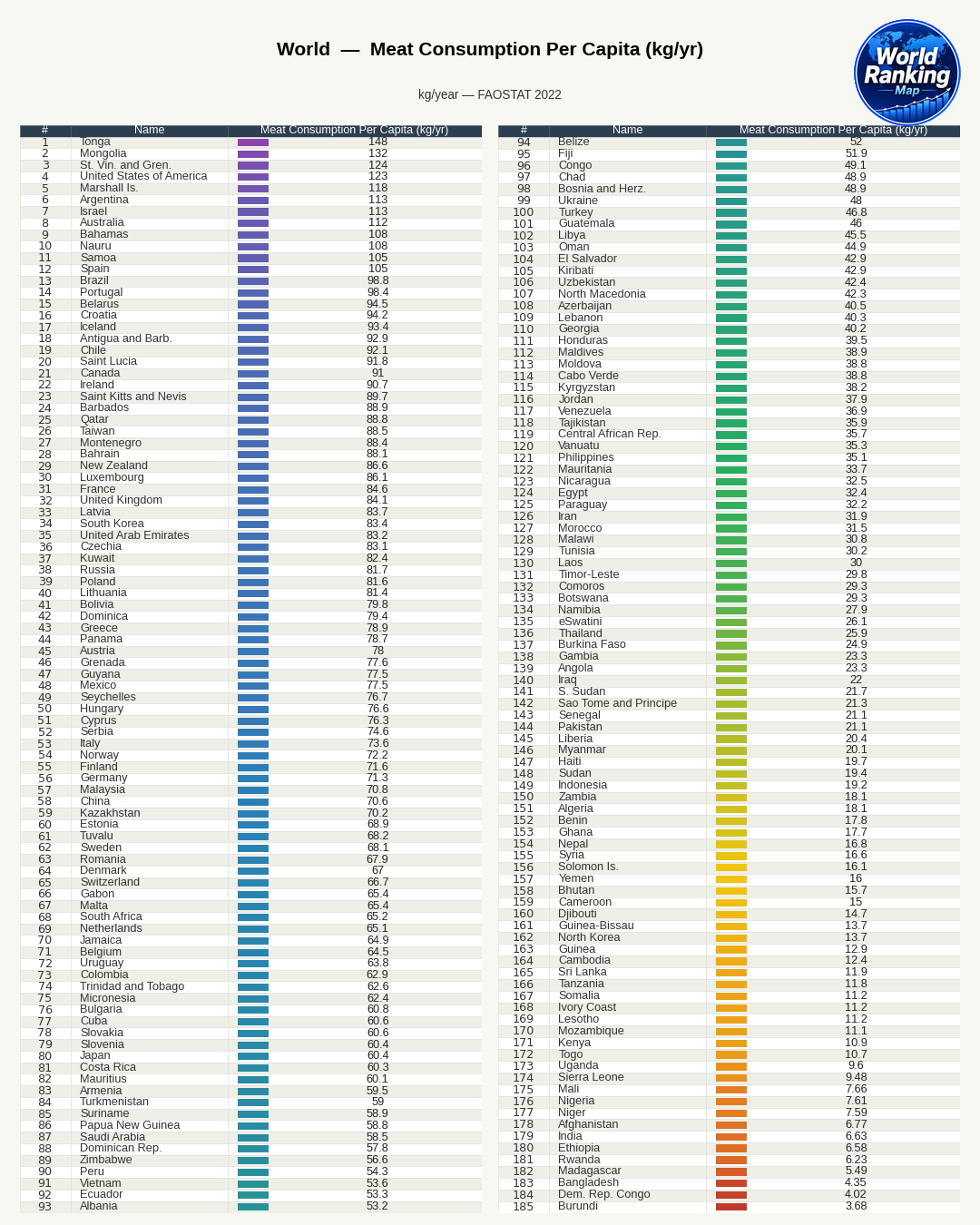
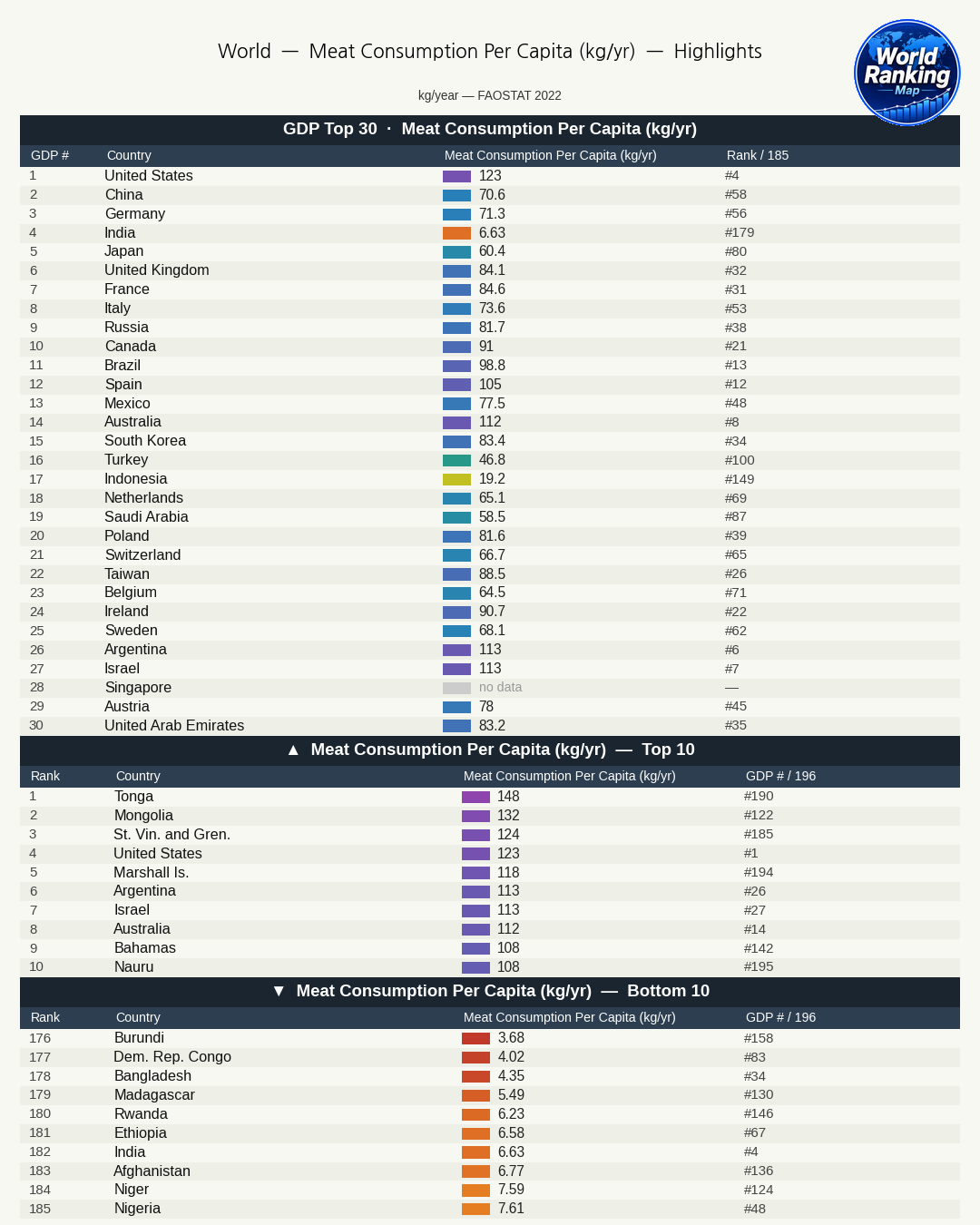
Even within the same region, per capita meat consumption can vary greatly by country. For example, within Europe, high-income countries in Western Europe and some countries in the Balkans or Eastern Europe differ in both consumption structure and level. In Asia as well, Japan, Korea, and China differ greatly from India, Bangladesh, and Pakistan. Africa also shows a clear gap between South Africa and low-income countries in sub-Saharan Africa.
These differences cannot be explained by income alone. Countries with a strong domestic production base are less vulnerable to import price shocks and are more likely to have high consumption as livestock industries develop. By contrast, countries that rely heavily on imported feed and meat, and are vulnerable to exchange-rate fluctuations, may see consumption fall more easily.
In addition, policy, taxation, and public health issues create gaps within regions. Some countries expand meat imports to stabilize food prices, while others encourage moderation in meat consumption as part of environmental goals or health policy. Diseases such as African swine fever and avian influenza can also disrupt supply and prices in specific countries, temporarily changing consumption rankings.
Ultimately, regional averages show the broad trend, but to understand the real market, it is necessary to look at country rankings and internal disparities as well. This is because economic structure, religion, agricultural productivity, and trade conditions differ even within the same continent.
Effects on Health, the Environment, and the Food Market
Meat consumption levels are directly linked to nutrition and health. In low-consumption regions, access to meat can be important for improving nutrition, as animal protein, iron, and vitamin B12 intake may be insufficient. On the other hand, in high-consumption regions, there is ongoing discussion about the health risks associated with excessive red meat and processed meat intake, including cardiovascular disease and some chronic illnesses. The key issue, then, is not simply how much is eaten, but whether the overall diet is balanced.
From an environmental perspective, meat, especially livestock based on ruminants, is closely tied to greenhouse gas emissions, land use, and water use. Beef and lamb are generally considered to have a larger environmental footprint than poultry, which is why discussions about dietary shifts are active in high-consumption regions. That said, production methods differ by region, so the environmental footprint can vary even for the same type of meat.
In terms of the food market and trade, meat consumption has major significance. Regions where consumption is rising quickly are closely linked to growth in feed grains, cold-chain logistics, processed foods, and the restaurant industry. By contrast, in regions where consumption is stagnating or declining, markets are likely to be reshaped by premium meats, animal welfare certification, low-carbon products, and alternative proteins.
- Health: Nutrition access matters in low-consumption regions; overconsumption management matters in high-consumption regions
- Environment: Livestock emissions and resource use are central policy issues
- Market: Closely connected to trade, feed, restaurants, and processed food industries
Outlook and Changes to Watch
Going forward, global per capita meat consumption is likely to move in different directions by region. In parts of Asia and Africa, rising incomes and urbanization may continue to push up both total and per capita consumption. In particular, the expansion of the middle class could strongly stimulate demand for poultry and processed meat.
By contrast, in some North American and European markets, changes in consumption quality and composition are likely to matter more than total volume. The share of red meat may decline, while chicken, higher-value products, and environmentally friendly or animal-welfare-certified products may grow. At the same time, flexitarian diets may spread, especially among consumers who are sensitive to health and climate issues.
The growth of alternative proteins is another important variable. Plant-based meat alternatives, cultivated meat, and fermentation-based proteins still account for only a small share of the overall market, but regulatory improvements, technological progress, and better price competitiveness could slow meat consumption growth in some high-consumption regions.
Policy changes also deserve attention. Carbon neutrality targets, stronger food labeling, public health recommendations, import regulations, and livestock disease response policies can all change both production and consumption. In the end, future meat consumption is not just a matter of eating because people are hungry; it should be understood as a complex indicator shaped by income, environment, technology, and values.
Taken together, the regional picture shows that the world is still in a phase of expanding meat consumption, but the way that expansion unfolds is becoming increasingly different from place to place. Some regions are experiencing quantitative growth, while others are undergoing qualitative transformation, and these differences will continue to reshape country rankings and the global food landscape.