Tourist Numbers and Appeal Factors of Major Tourism Powerhouses
What Is a Tourism Powerhouse?
A tourism powerhouse does not simply mean a country with famous travel destinations. In general, it refers to a country with a large inflow of international tourists, a high share of tourism in the national economy, and stable demand over a long period of time. To be considered a true tourism powerhouse, it must also have global recognition, tourism infrastructure, accessibility, and a strong brand image.
When comparing tourist numbers, it is important to look at several key criteria rather than just visitor counts alone. Representative indicators include the number of international tourists, tourism revenue, average length of stay, per-capita spending, repeat visitation rate, and the degree of seasonal demand dispersion. For example, even if a country receives many visitors, the economic impact may be limited if stays are short and spending is low.
Also, even with the same number of tourists, the structure can differ greatly from country to country. Some countries receive many short visits by car or train from neighboring countries, while others attract high-value tourists through long-haul air travel. Therefore, to understand tourism powerhouses, it is necessary to look at both quantitative scale and qualitative performance.
The Current State of Tourist Numbers in the World’s Major Tourism Powerhouses
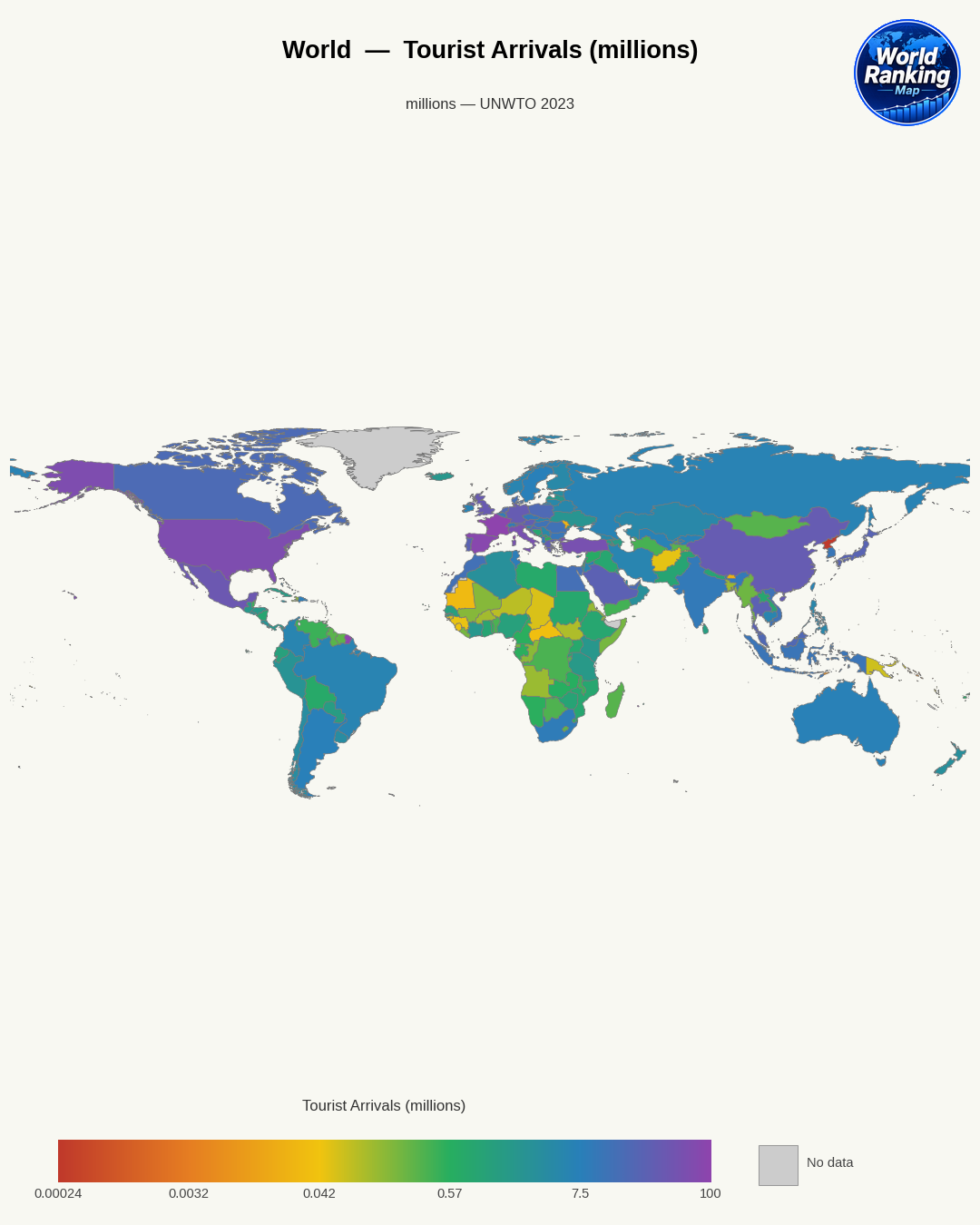
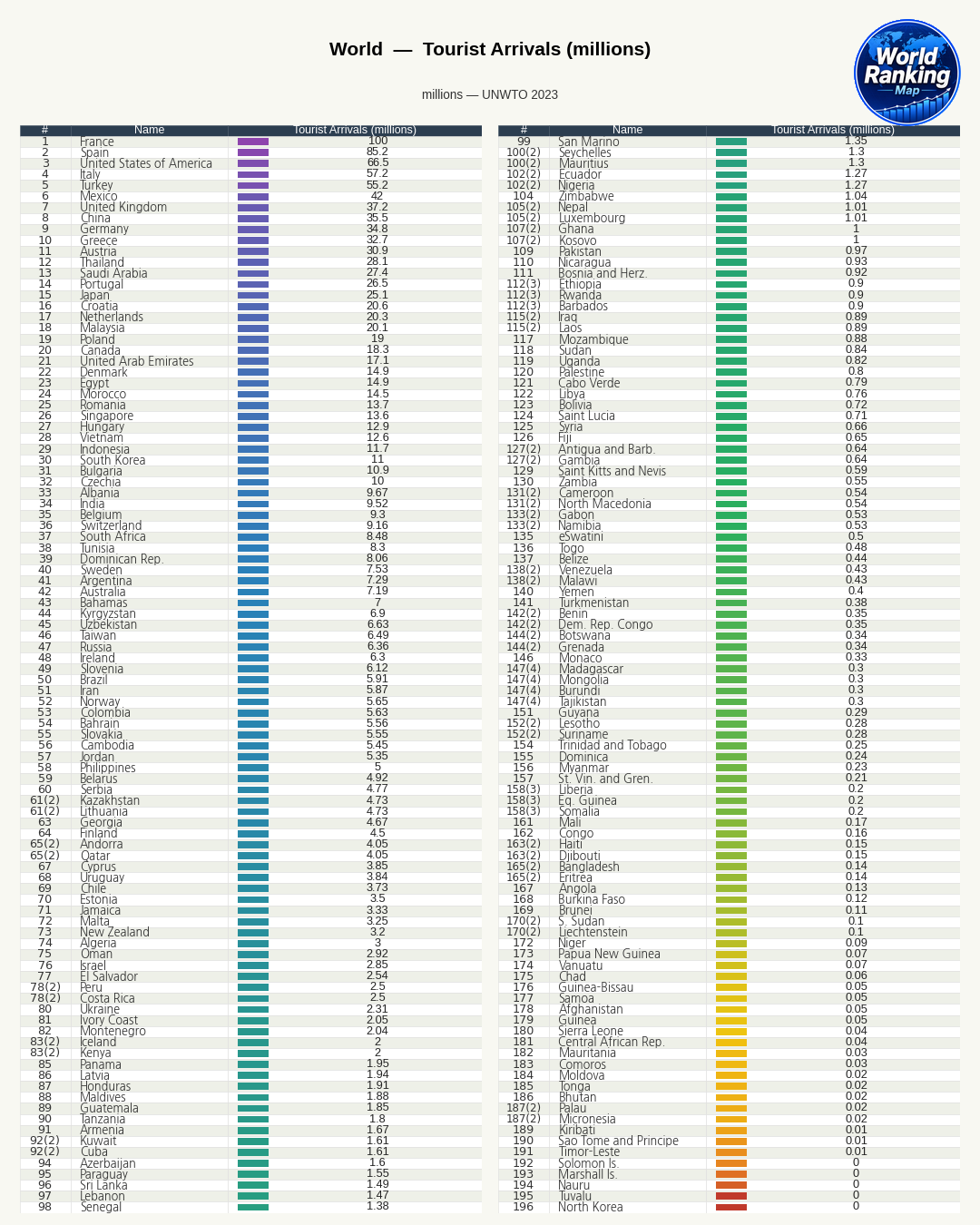
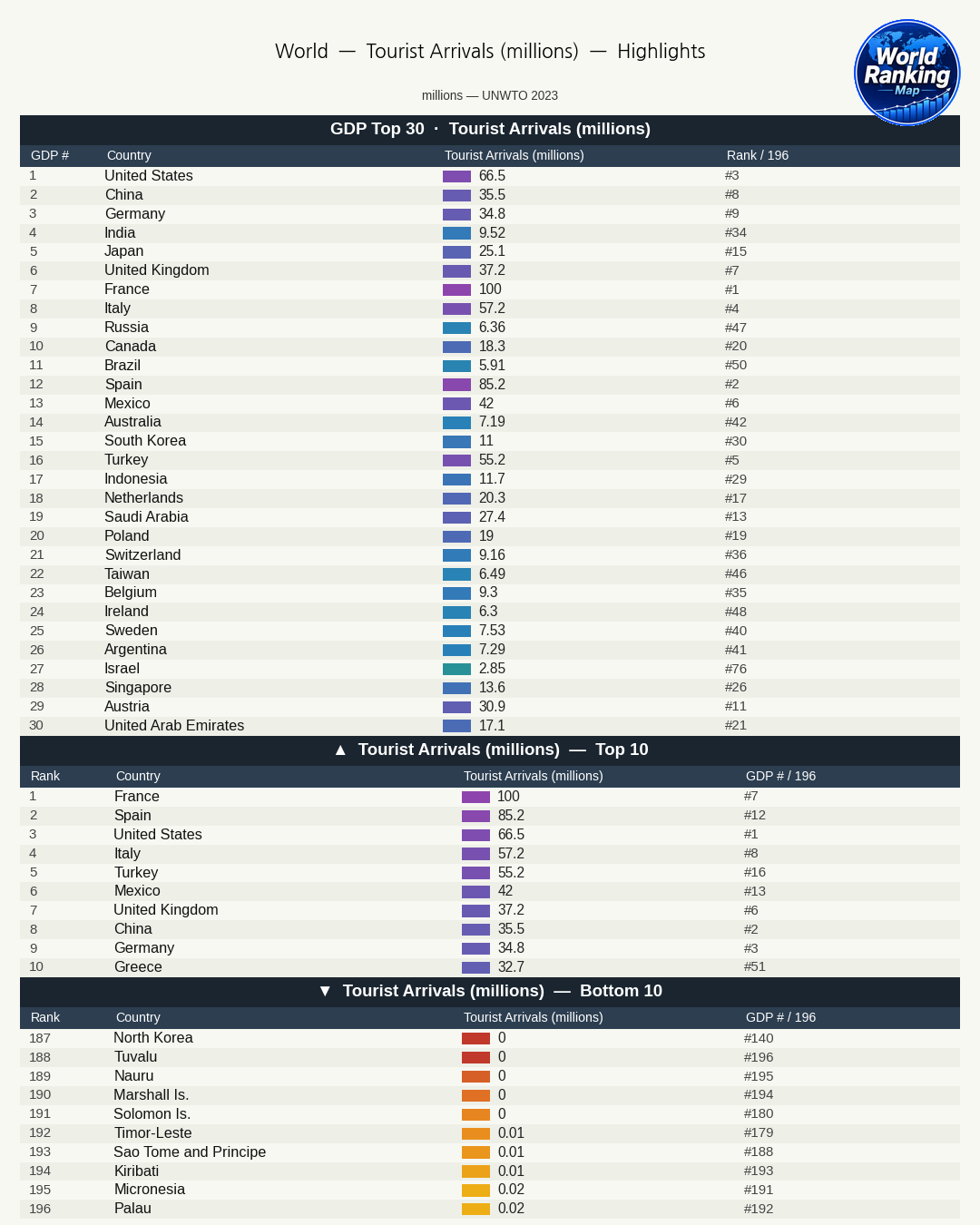
In global tourism statistics, the representative tourism powerhouses often mentioned are France, Spain, the United States, Italy, and Türkiye. These countries have shown differences in ranking and recovery speed before and after the pandemic, but they still form the core of the global tourism market.
France has long been regarded as one of the world’s top destinations for international tourist arrivals. Its strengths include the massive city brand of Paris, iconic attractions such as the Louvre Museum and the Eiffel Tower, wine and gastronomy, and diverse regional assets stretching from southern France to the Alps. Spain also remains among the world’s leaders in international tourist arrivals, with a combination of beach and city tourism in places such as Barcelona, Madrid, Andalusia, the Balearic Islands, and the Canary Islands.
The United States is also a very large market in terms of international tourist arrivals, but it often shows overwhelming competitiveness especially in tourism revenue. Major cities and entertainment hubs such as New York, Las Vegas, Los Angeles, and Orlando are major draws, and national park tourism is also globally popular. Italy consistently ranks near the top thanks to its concentration of historical, artistic, and leisure resources such as Rome, Venice, Florence, Milan, and the Amalfi Coast.
Türkiye is one of the tourism powerhouses that has attracted particular attention in recent years. International tourist inflows have expanded rapidly thanks to Istanbul’s historical significance and unique cultural position, the scenery of Cappadocia, Mediterranean resort areas, and relatively competitive prices. Its geographic location connecting Europe, the Middle East, and Asia is also an advantage.
Recent trends show the following characteristics:
- Post-pandemic recovery: European countries rebounded quickly thanks to the recovery of intra-regional travel and the normalization of air routes.
- Strength in short-haul travel: When uncertainty is high, short-distance tourism centered on neighboring countries tends to recover first.
- Simultaneous recovery of city and resort tourism: Demand for urban cultural tourism and beach resorts increased together.
- Greater importance of price competitiveness: Tourist flows are moving sensitively in response to inflation and exchange-rate changes.
Latest country-by-country figures may vary somewhat depending on the reporting organization and methodology, but in broad terms there is little disagreement that France, Spain, the United States, Italy, and Türkiye are the key countries in the global tourism market.
Key Appeal Factors That Attract Tourists
The reasons tourists choose a particular country vary widely, but they can generally be summarized into several common appeal factors. The most basic is natural scenery. Natural assets such as beaches, mountains, lakes, deserts, islands, and national parks create seasonal demand and form the basis of resort and activity tourism.
The second is cultural heritage and historical depth. Old cities, palaces, cathedrals, ruins, museums, and works of art are core assets of tourism powerhouses. In countries with dense historical layers, such as France and Italy, entire cities can become tourism content. Tourists want not only to see scenery, but also to experience the stories and identity unique to that country.
The third is food. Gastronomy is no longer a secondary factor; it is now a major reason for travel. French haute cuisine, Italian pasta and pizza, Spanish tapas, Turkish kebabs and desserts, and the diverse multicultural cuisine of the United States each attract tourists in different ways. Food also has a major impact on satisfaction during the stay and willingness to return.
The fourth is shopping and urban experiences. Luxury shopping, local markets, department stores, design products, and entertainment facilities are especially important in city tourism. Cities such as Paris, Milan, New York, and Barcelona are prime examples of tourism combined with consumption.
The fifth is festivals and events. Carnivals, music festivals, sporting events, fashion weeks, and Christmas markets create concentrated tourism demand during specific periods. These events also help offset off-season demand and strengthen city branding.
Finally, climate is also very important. Warm winters, mild springs and autumns, and long summer seasons are favorable for resort tourism. In particular, a Mediterranean climate is a powerful attraction for tourists coming from Northern Europe or colder regions.
Comparing the Representative Strengths of Each Country
Although each tourism powerhouse may look similar, the structure of its competitiveness is actually different. France’s strength lies in its comprehensiveness. It has a broad portfolio that includes world-class city tourism, art and fashion, gastronomy, wine, rural tourism, and ski tourism. In other words, it is not dependent on a single factor; its overall tourism brand is highly complete.
Spain is strong in the combination of beach resorts and urban culture. Its advantages include Mediterranean resorts and island tourism, architecture and art, vibrant nightlife, and a relatively long tourism season. It holds a particularly strong position in Europe’s mass tourism market.
The United States is defined by scale and diversity. It includes giant cities, theme parks, shopping, performances, sports, national parks, and road-trip culture. In addition, business travel, international conferences, study abroad, and visits to friends and relatives all combine to create a very broad tourism base.
Italy has an overwhelming historical, artistic, and romantic image. Each city is a world-class tourism brand, and architecture, fine art, religious heritage, gastronomy, and fashion are strongly connected. For travelers, one major advantage is the ability to enjoy a high-density experience even on a short itinerary.
Türkiye’s strengths are its unique identity at the crossroads of East and West and its price appeal. It offers abundant historical sites, the atmosphere of the Islamic cultural sphere, European-style resorts, and visually striking content such as hot-air balloons and coastal resorts. It is especially competitive for tourists who value affordability.
In summary:
- France: A comprehensive tourism powerhouse, symbol of art, fashion, and gastronomy
- Spain: A balance of beach resorts and urban culture
- United States: A giant market with entertainment and natural diversity
- Italy: Historical, artistic, and emotionally resonant travel image
- Türkiye: A unique cultural crossroads with price competitiveness
The Impact of Tourism Infrastructure and Accessibility
No matter how many attractive tourism resources a country has, tourist numbers are hard to grow if access is difficult and movement is inconvenient. That is why one common trait of tourism powerhouses is strong infrastructure. The first major factor is air connectivity. Large international airports, a wide range of direct flights, and links with low-cost carriers are basic conditions for attracting tourists.
European tourism powerhouses have dense intra-regional air and rail networks, making travel between countries easy. France, Spain, and Italy all have well-developed high-speed rail and regional rail systems, which improves convenience for travel between cities. This encourages tourists to travel around multiple regions within one country and leads to longer stays and higher spending.
Accommodation diversity is also important. The wider the range of options—luxury hotels, mid-range and budget hotels, hostels, resorts, and short-term rentals—the more consumer segments can be accommodated. In particular, major tourism countries have structures that can serve family travelers, backpackers, luxury travelers, and group tourists alike.
Safety and hygiene, tourist information services, and multilingual support also have a major impact on the tourist experience. Tourists prefer countries that are not only rich in attractions, but also easy to navigate, easy to get information from, and perceived as safe. Services such as mobile payments, online booking, digital tickets, and real-time transportation information are becoming increasingly important.
In addition, visa policy directly affects tourist numbers. Visa-free entry, e-visas, and simplified entry procedures lower barriers to travel. Conversely, complicated visa issuance or strict entry screening can reduce tourism demand. In countries like the United States, where the appeal is very strong but entry procedures are relatively strict, this can become a variable.
External Variables Such as Seasonality, Exchange Rates, and International Conditions
Tourist numbers are not determined by a country’s appeal alone. External variables such as seasonality, exchange rates, economic conditions, and international circumstances have a major impact. For example, beach-oriented tourism countries depend heavily on the summer peak season, while ski tourism countries are sensitive to winter weather conditions. The more severe the seasonal concentration, the more unstable employment and revenue can become.
Exchange rates are a very direct factor in tourism demand. When a country’s currency weakens, travel becomes relatively cheaper for foreign visitors, which can increase its appeal. Türkiye’s recent attention in terms of price competitiveness is partly due to this factor. Conversely, rising prices and a strong currency can increase the burden on tourists.
The international economic situation is also important. During economic downturns, short-haul travel tends to increase relative to long-haul travel, and budget travel is preferred over expensive trips. Rising airfares and fuel prices are major factors that suppress travel demand.
The pandemic was a representative example of how vulnerable the tourism industry is to external shocks. Border closures and travel restrictions caused international tourist numbers to plummet, and recovery afterward varied greatly by country. Health regulations, vaccine policies, the speed of airline recovery, and the availability of domestic tourism alternatives all affected outcomes.
Finally, geopolitical risks and security issues cannot be ignored. War, terrorism, diplomatic conflict, social unrest, and large-scale protests have an immediate effect on tourists’ perceptions. Because tourism is an industry where psychological safety matters, not only the actual level of risk but also the image formed in the international community is extremely important.
Limits of Looking Only at Tourist Numbers and the Importance of Sustainability
International tourist arrivals are the most visible indicator, but they cannot fully explain the performance of a tourism powerhouse on their own. The first thing to consider alongside them is tourism revenue. Even if the number of visitors is somewhat lower, the economic impact can be greater if the country encourages longer stays and higher spending. In this respect, the United States is highly competitive not only in visitor numbers but also in spending volume.
In addition, average length of stay and per-capita spending are key indicators of tourism quality. Mass tourism with short visits and tourism that keeps people longer while spending money in the local economy have different effects. Their impact on local businesses, cultural facilities, transportation, and accommodation industries also differs.
Recently, the issue of overtourism has become an important topic. In places such as Venice, parts of Barcelona, and some areas of Paris, an excessive influx of tourists can cause inconvenience to residents, rising rents, environmental damage, and harm to cultural heritage. This means that having many tourists is not necessarily a purely positive thing.
Environmental burdens are also increasing. Carbon emissions from rising air travel, waste problems in beach and mountain areas, increased water use, and ecosystem damage all threaten sustainability. Therefore, in the future, it is likely to become more important not simply how many tourists come, but how balanced and sustainably the tourism industry is managed.
When assessing sustainability, it is also necessary to look at the following indicators:
- Tourism revenue and spillover effects on the local economy
- Average length of stay and repeat visitation rate
- Per-capita spending and the share of high-value-added tourism
- Environmental burden and the level of carbon-emission management
- Resident acceptance and impact on living conditions
Changes and Outlook for Tourism Powerhouses to Watch in the Future
In the future, the global tourism market is likely to maintain its structure centered on existing powerhouses, while also undergoing several important changes. First is the rise of emerging tourism countries. Some countries in the Middle East, Southeast Asia, Eastern Europe, and North Africa are rapidly increasing their presence through large-scale investment, airport hub strategies, resort development, and digital marketing.
Second, the expansion of digital tourism services is expected to accelerate further. Mobile booking, e-visas, AI-based travel recommendations, self-service check-in, multilingual translation services, and real-time congestion information are transforming the tourist experience. Countries that successfully complete digital transformation are likely to gain an advantage in convenience and satisfaction.
Third, sustainable tourism is becoming a core competitive factor. Eco-friendly transportation, visitor dispersal policies, profit-sharing with local communities, heritage preservation, and carbon reduction efforts can directly affect a country’s brand in the future. Tourists themselves are increasingly considering ethical consumption and environmental impact, not just price and convenience.
Fourth, tourism demand is becoming more segmented. Beyond travel centered on popular attractions, wellness tourism, gastronomy tourism, sports tourism, long-stay travel combined with remote work, and film- and drama-location tourism are all growing. This also means that simply having famous attractions is no longer enough for a tourism powerhouse.
In the end, the tourism powerhouses of the future are likely to be countries that go beyond merely attracting large numbers of tourists and instead maintain a balanced combination of accessibility, brand strength, digital capability, and sustainability. Existing powerhouses such as France, Spain, the United States, Italy, and Türkiye remain strong, but their future rankings and influence may change depending on how quickly they adapt to evolving travel trends.