Countries with High Patent Counts Relative to Population and Their Characteristics
What Does Patent Count Relative to Population Mean
Patent count relative to population is an indicator calculated by dividing a country’s number of patent applications or registrations by its total population. It is often standardized for comparison, such as patents per 1 million people. Looking only at absolute patent counts favors countries with large populations and economies like the United States, China, and Japan, but using a population-adjusted measure allows us to see innovation density that partly corrects for differences in national scale.
This indicator matters because patents are not just administrative statistics; they are signals that reflect a country’s R&D activity, technology commercialization, and industrial competitiveness. In particular, if a small country has a high patent count relative to population, it can be interpreted as meaning that intellectual property creation is active within a limited population base.
That said, patent count relative to population is only one aspect of innovation capability. Because the figure can vary depending on how the patent system is used, industrial structure, and companies’ filing strategies, it is best viewed alongside other indicators.
Countries with the Highest Patent Counts Relative to Population
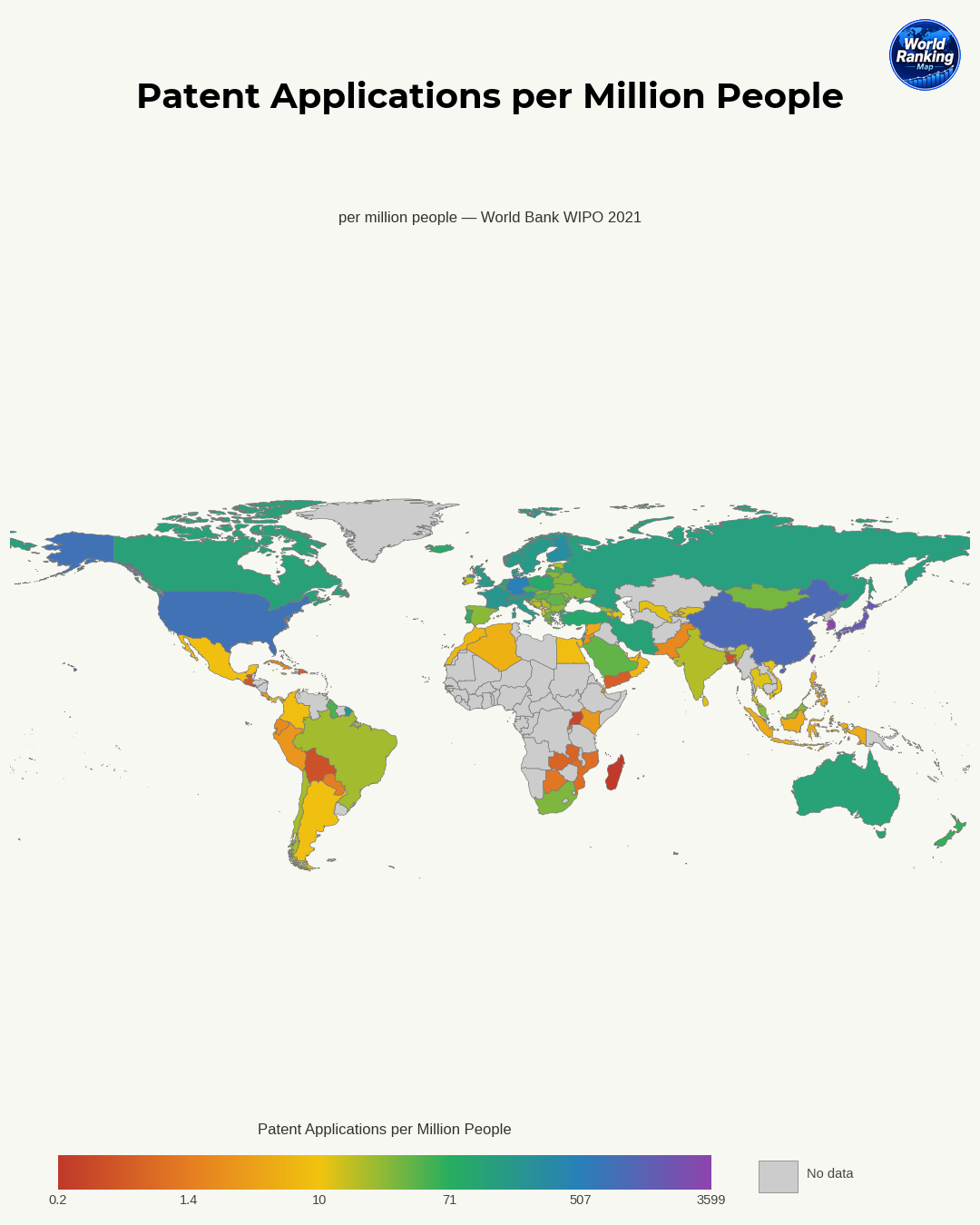
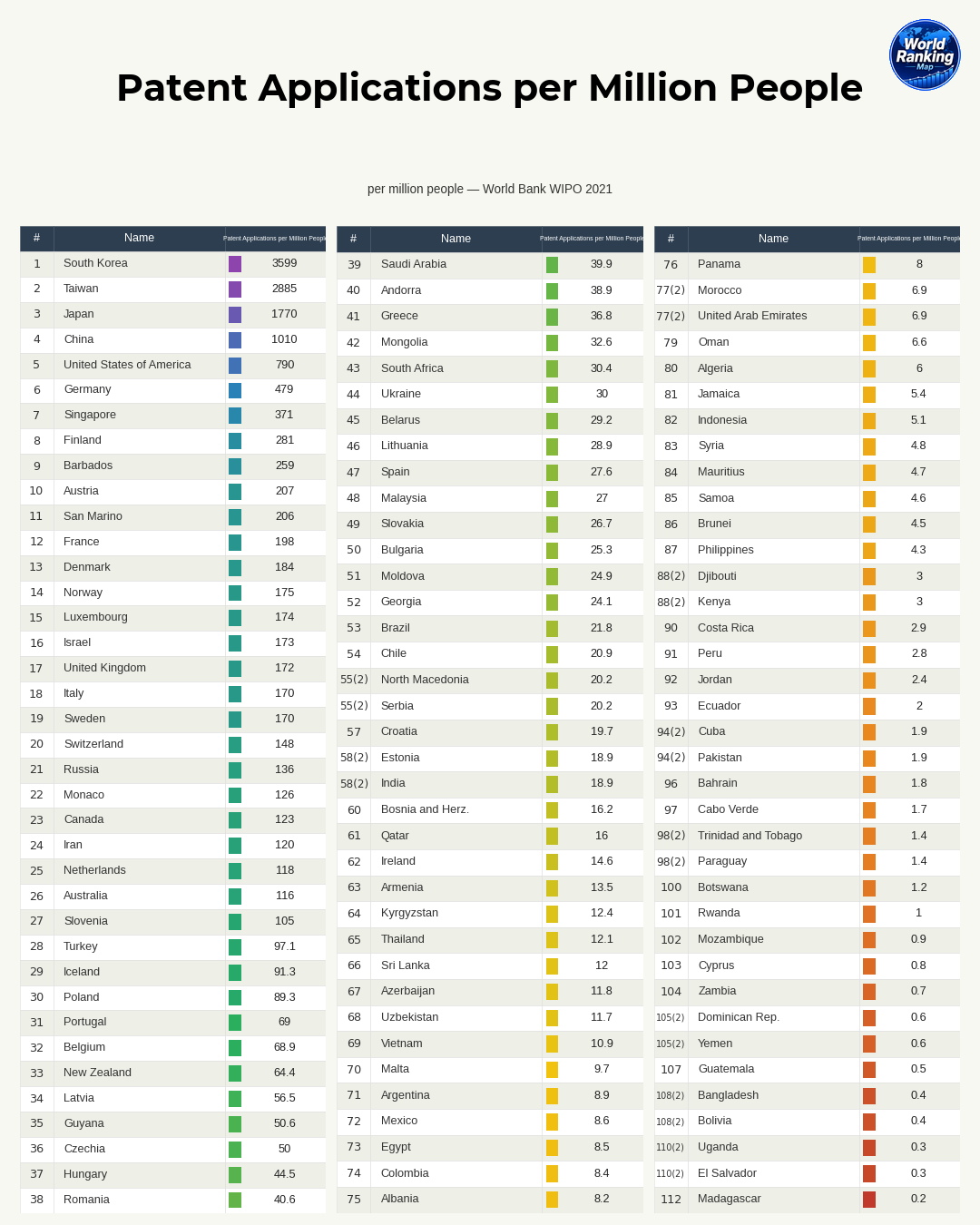
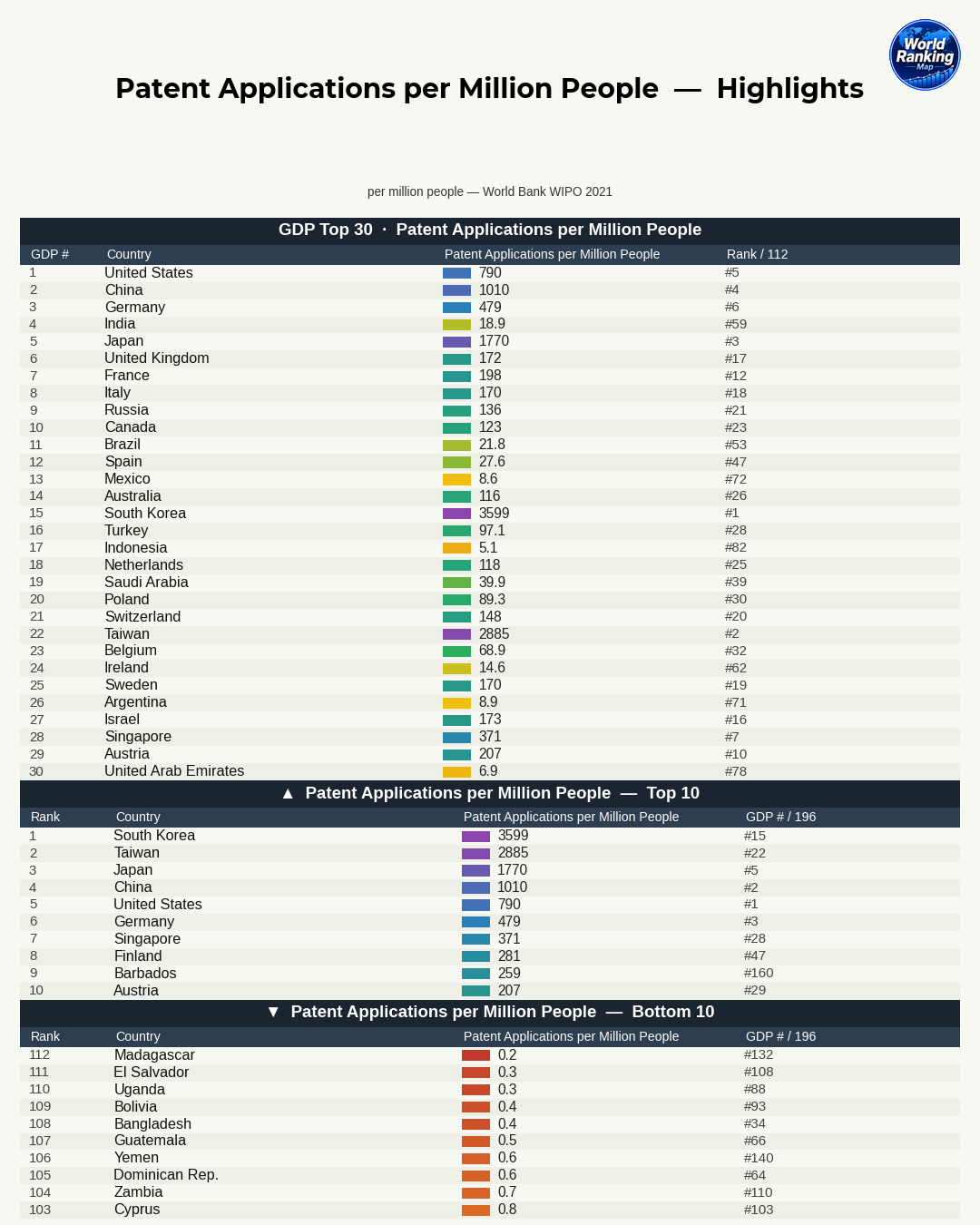
In recent international comparisons, countries frequently mentioned as having high patent application and registration counts relative to population include Switzerland, South Korea, Japan, Sweden, Finland, Denmark, Germany, the Netherlands, Israel, and Singapore. Rankings vary depending on whether the measure is domestic filings, international patents (PCT), or registrations, but the countries that repeatedly appear near the top are relatively similar.
One especially notable point is that the countries at the top are not necessarily large-population nations. Rather, countries with relatively small populations but high R&D intensity often stand out. Switzerland and the Nordic countries are representative examples, while South Korea and Japan have maintained high patent density based on their manufacturing-driven technological accumulation.
Common characteristics of the countries that are often highlighted include the following.
- Switzerland: centered on high-value-added industries such as pharmaceuticals, precision instruments, and chemicals
- South Korea: strong in technology-intensive industries led by large corporations, including semiconductors, electronics, telecommunications, and batteries
- Japan: long-accumulated patent capability in automobiles, materials, robotics, and electronics
- Sweden, Finland, and Denmark: competitiveness in telecommunications, green technology, biotech, and industrial automation
- Israel: an innovation ecosystem centered on software, security, semiconductor design, and medical technology
- Singapore: a combination of global company attraction and state-led R&D strategy
In other words, countries with high patent counts relative to population tend to be either small but technologically strong nations or highly advanced manufacturing and knowledge-intensive economies.
Common Characteristics of Top-Ranking Countries
Countries with high patent counts relative to population share several structural characteristics. The most important factor is high R&D investment. The higher a country’s R&D spending as a share of GDP, the more likely new technologies and inventions are to result in patents. South Korea, Israel, Sweden, and Switzerland are all considered representative R&D-intensive countries.
The second factor is a dense concentration of highly skilled talent. There must be enough highly trained people—scientists, engineers, doctors, data specialists, and materials engineers—for patentable technologies to emerge continuously. These countries generally have high levels of higher education, and their graduate schools and industrial research institutes are also strong.
The third factor is industrial sophistication. Patents do not come equally from all industries. Fields such as pharmaceuticals, semiconductors, precision machinery, biotech, telecommunications equipment, and advanced materials are highly patent-dependent. By contrast, economies with a very large service sector or those centered on low-value-added assembly industries may show relatively low patent counts relative to population.
The fourth factor is collaboration among universities, companies, and research institutes. Patent creation becomes more active when basic research is handled by universities and public research institutions, while applied research and commercialization are handled by companies. Institutional mechanisms such as technology transfer systems, industry-academia collaboration funds, and joint research projects also play important roles.
In summary, the common foundation of top-ranking countries is as follows.
- High R&D spending as a share of GDP
- A strong supply of STEM-oriented talent
- An advanced industrial structure that is favorable to patents
- Close cooperation among universities, companies, and public research institutions
- Stable intellectual property protection systems and commercialization environments
Strategies of Patent Powerhouses Seen Through Country Cases
Switzerland is a country with a small population but is consistently ranked among the very top in patent counts relative to population. Its strengths lie in pharmaceuticals, life sciences, chemicals, and precision instruments. Global pharmaceutical companies, research-oriented universities, and highly skilled technical talent are tightly connected, and the country is also highly regarded in terms of patent quality. Switzerland’s strategy is closer to focusing on high-value-added technologies than on mass production.
South Korea is a representative case of a country that rose rapidly to become a patent powerhouse. In semiconductors, displays, smartphones, telecommunications equipment, batteries, and automotive electronics, large corporations and their suppliers have accumulated patents on a massive scale. The combination of government industrial policy, a strong emphasis on education, and a culture of rapid technology commercialization has pushed patent counts relative to population to very high levels. More recently, the focus has expanded to AI, biotech, robotics, and next-generation semiconductors.
Japan has a very solid patent base, as expected of a long-standing manufacturing powerhouse. It has strong accumulated technological capabilities in automobiles, industrial machinery, robotics, electronics, batteries, and materials, and its in-house corporate research lab culture has long been well developed. Japan’s strength lies in long-term technological accumulation and precision-improvement innovation rather than short-lived trends. However, in recent years, the pace of digital transformation and adaptation to new industries has also been identified as an important challenge.
The Nordic countries show highly efficient innovation systems despite their small size.
- Sweden: strong in telecommunications, industrial automation, green technology, and medical technology
- Finland: expanding from a tradition in telecommunications into software, gaming, and deep tech
- Denmark: competitiveness in biotech, pharmaceuticals, energy efficiency, and maritime and green technologies
A common feature of these countries is that the welfare state model and innovation policy coexist without conflict. Education, research, startup support, and digital infrastructure are stably supported, allowing them to maintain global patent competitiveness despite being medium- or small-sized economies.
What Cannot Be Understood from Patent Counts Alone
A high number of patents does not necessarily mean high-quality innovation. The first thing to examine is patent quality. Citation counts, usefulness in international markets, actual commercialization, and litigation or licensing value should all be considered. A country may have many patents with low impact, while another may have only a few but possess core patents with major industrial spillover effects.
The share of international patents is also important. Compared with cases where only domestic filings are numerous, a higher number of international filings aimed at securing rights in multiple countries suggests stronger global commercial potential for the technology. That is why PCT international filing statistics are often used when comparing technological competitiveness among countries.
Differences in industrial structure also have a major effect on interpretation. Countries with a large share of patent-dependent industries such as pharmaceuticals, semiconductors, and chemicals have an advantage. By contrast, economies centered on finance, tourism, logistics, or platform services may show less of their innovation activity in patent statistics.
Finally, the influence of multinational corporations cannot be ignored. In some countries, patents are concentrated because headquarters are located there, even though actual R&D and production are distributed across multiple countries. Conversely, in countries with active foreign-affiliated research centers, there may be a gap between the domestic innovation ecosystem and the statistics.
Therefore, when looking at patent counts relative to population, it is advisable to check the following as well.
- Patent quality and commercialization outcomes
- The share of international patent applications
- Differences in patent dependence by industry
- The concentration of filings by large corporations and multinational companies
How Patent Counts Relative to Population Affect the Economy and Industry
Countries with high patent counts relative to population generally have greater potential for productivity improvement. When new processes, materials, software, and equipment are applied in industry, higher value can be created with the same labor and capital. In the long run, this also affects wage levels, corporate profitability, and national competitiveness.
Patents are also linked to export competitiveness. In industries where patent protection is important—such as semiconductors, pharmaceuticals, precision machinery, telecommunications equipment, and green technologies—technological superiority can translate directly into market share. Countries with strong patent portfolios are advantageous not only in price competition but also in terms of technology standards and barriers to market entry.
They also have a positive effect on the startup ecosystem. Technology-based startups can use patents to explain technological exclusivity and growth potential to investors. Especially in biotech, deep tech, semiconductor design, robotics, and cleantech, patents play a major role in fundraising and company valuation.
Furthermore, a high patent count relative to population suggests that a country may be moving toward advanced industries at a faster pace. As economies shift from simple manufacturing to design, core technologies, platforms, and high-end components, their overall quality also rises.
Countries and Trends to Watch Going Forward
In the future, the rise of emerging innovation countries may become more pronounced beyond the traditional patent powerhouses. In addition to countries such as Israel, Singapore, and Taiwan, which already show high technological density, some countries in the Middle East, Eastern Europe, and Southeast Asia are rapidly increasing their presence in specific fields. In particular, countries investing heavily in semiconductors, batteries, AI, biotech, defense industries, and clean energy are drawing attention.
Reorganization by technology field is also an important trend. In the past, patents in electronics, machinery, and chemicals were central, but in the future, the share of artificial intelligence, quantum technology, biopharmaceuticals, next-generation batteries, hydrogen, and climate technology is likely to grow. Accordingly, it is also a point of interest whether traditional manufacturing powerhouses will continue to maintain their advantage or whether countries centered on software and life sciences will rise more quickly.
Changes in government policy can also alter the competitive landscape. Policies such as tax credits, R&D subsidies, university technology transfer systems, foreign talent attraction, and faster patent examination can directly affect patent counts relative to population. At the same time, U.S.-China technological competition, supply chain restructuring, and stronger economic security concerns are changing companies’ filing strategies and the regions where they invest in R&D.
Ultimately, the patent competition of the future is likely to favor not the countries that simply file the most patents, but those that continuously create high-quality patents in key technology fields and successfully industrialize them. Beyond competing in numbers, the ability to connect patents to real growth and industrial leadership is becoming more important.