Major Countries with Advanced Manufacturing and Their Distinct Characteristics
The Meaning of Manufacturing and Its Role in the Global Economy
Manufacturing refers broadly to industries that process and assemble raw materials or components to create new products. This includes food processing, textiles, chemicals, steel, automobiles, semiconductors, machinery, and electronics production. It is not merely about making goods in factories; it is also closely linked to research and development, design, quality control, logistics, and services, and functions as a core pillar of the national economy.
In the global economy, manufacturing has a major impact on job creation, export expansion, technological innovation, and productivity improvement. Countries with a strong manufacturing base generally produce high-value-added goods, secure competitiveness in the global market, and strengthen their trade balance and industrial ecosystem through that strength. Manufacturing is also closely connected to the service sector, driving growth in related industries such as finance, transportation, software, and engineering.
Key Criteria for Identifying Countries with Advanced Manufacturing
When evaluating manufacturing powerhouses, it is important to look at more than just production volume. Because each country has different strengths, they are sometimes classified as scale-based manufacturing powers or high-value-added manufacturing powers.
The main criteria are as follows.
- Production scale: how large the total manufacturing output and industrial share are
- Export competitiveness: how well domestic products sell in the global market
- Technological capability: the level of R&D investment, patents, and advanced industry capacity
- Supply chain development: how efficiently raw materials, components, assembly, and logistics are connected
- Labor productivity: how much value is created with the same labor force
- Industrial diversification: whether multiple manufacturing sectors are developing in a balanced way rather than relying on a single industry
- Infrastructure and institutions: whether power, ports, roads, communications, legal and regulatory systems, and financial conditions are favorable to manufacturing
Depending on these criteria, some countries excel in mass production, while others hold an advantage in technology-intensive fields such as precision machinery or semiconductors.
Overview of Major Countries with Advanced Manufacturing
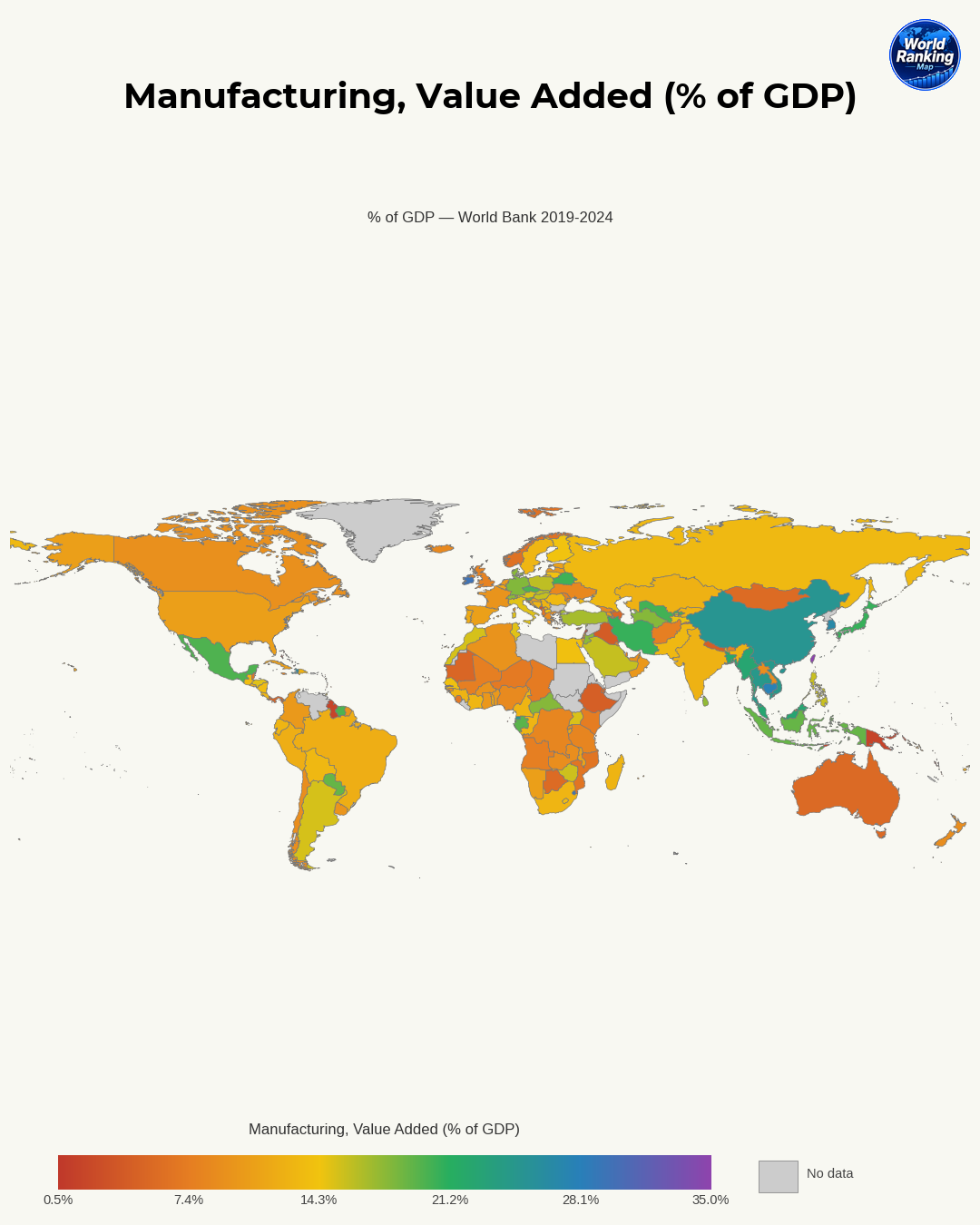
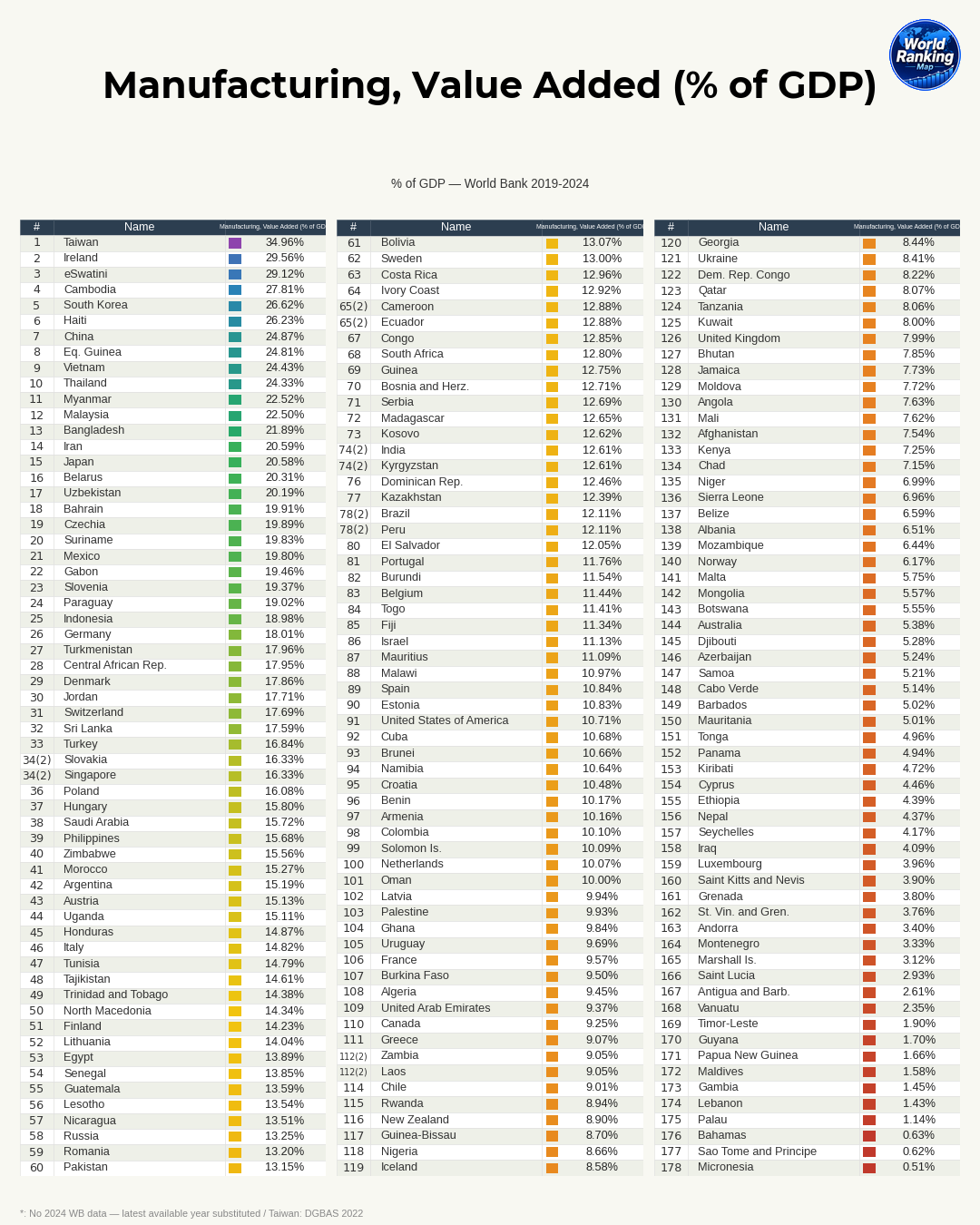
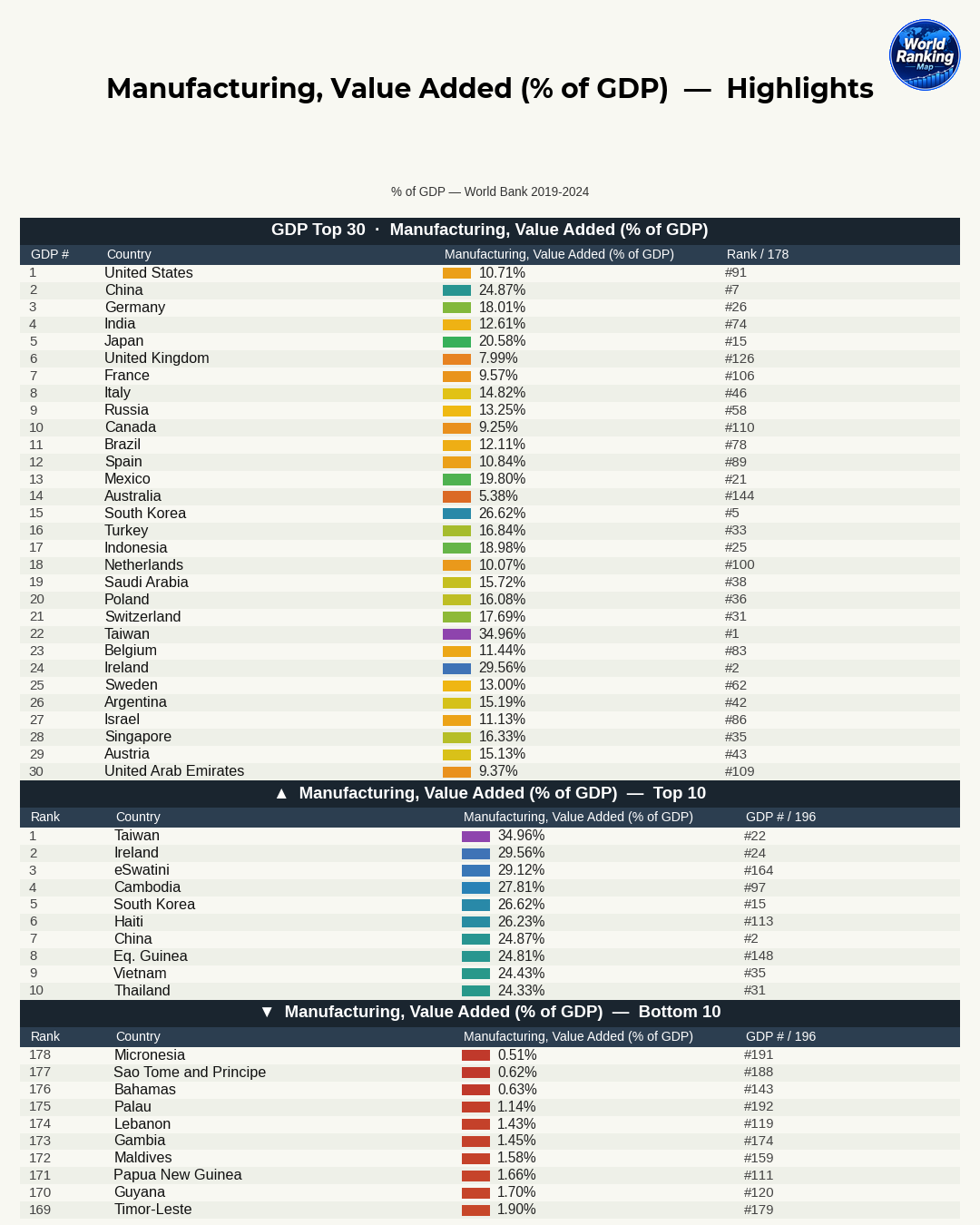
Today, the countries that represent global manufacturing are China, the United States, Germany, Japan, and South Korea. In addition, Taiwan, Italy, India, Vietnam, and Mexico are also becoming increasingly important.
China is the world’s largest manufacturing producer, and its greatest strength lies in its vast production capacity and fully developed supply chains. The United States stands out in advanced manufacturing combined with aerospace, semiconductor equipment, medical devices, and software. Germany maintains world-class competitiveness in precision machinery, automobiles, and industrial equipment. Japan is strong in materials, components, and equipment, as well as robotics and advanced manufacturing processes, while South Korea shows high concentration and rapid execution in semiconductors, electronics, automobiles, and shipbuilding.
A comparison of each country’s strengths is as follows.
- China: scale, speed, and supply chain density
- United States: innovation, advanced technology, and high-value-added industries
- Germany: precision, industrial machinery, and manufacturing quality
- Japan: materials and components competitiveness, process technology, and automation
- South Korea: semiconductors, electronics, shipbuilding, and an export-oriented manufacturing structure
China: The World’s Largest Production Base and Massive Supply Chain
China is currently regarded as the largest manufacturing country in the world. It has large-scale production capacity across nearly every manufacturing sector, including electronics, machinery, steel, chemicals, home appliances, textiles, and consumer goods. In particular, its extensive industrial parks, ports, logistics networks, and abundant ecosystem of partner suppliers are core competitive advantages of Chinese manufacturing.
One of the defining features of Chinese manufacturing is its integrated supply chain. Within a single region, raw material procurement, component production, assembly, packaging, and export can all take place quickly, giving China an edge in both speed and cost. In sectors such as smartphones, home appliances, batteries, and solar equipment, China also holds a very high share of the global market.
China is also gradually moving beyond simple assembly toward high-value-added industries. It continues to make large-scale investments in electric vehicles, batteries, industrial robots, telecommunications equipment, and semiconductor development, while its enormous domestic market serves as an important foundation for manufacturing growth. The fact that domestic consumption supports production, not just exports, is a major advantage compared with other manufacturing powers.
However, China still faces dependence issues in high-end semiconductors, critical equipment, and some advanced technologies, and rising labor costs and geopolitical tensions are also seen as medium- to long-term challenges.
The United States, Germany, and Japan: Characteristics of High-Value-Added Manufacturing Powers
The United States, Germany, and Japan are all manufacturing powers, but the structure of their competitiveness differs.
The United States is the center of advanced manufacturing. It has a strong edge in aerospace, defense, pharmaceuticals, semiconductor design, semiconductor equipment, medical devices, and manufacturing that integrates precision software. While some mass production has moved overseas, the country remains extremely strong in core technologies, high-value-added processes, intellectual property, and platform dominance. Recently, there has also been a clear trend toward expanding domestic investment in semiconductors, batteries, and green manufacturing for reasons of supply chain stability and industrial security.
Germany is the center of manufacturing in Europe and has world-class competitiveness in automobiles, industrial machinery, chemicals, electrical equipment, and factory automation. The core of German manufacturing is its high quality standards, precision, and a strong industrial ecosystem centered on mid-sized and small firms. The specialized companies known as the Mittelstand often lead the global market in specific components or equipment categories. Germany is also characterized by its high export dependence and close integration with European supply chains.
Japan is extremely strong not only in finished products but also in materials, components, and equipment. It has long maintained competitiveness in semiconductor materials, fine chemicals, sensors, machine tools, industrial robots, and battery-related technologies. Japanese manufacturing is distinguished by quality control, process stability, and long-term technological accumulation, and global manufacturers often rely on key Japanese components. However, sluggish domestic growth, aging demographics, and intensifying international competition in some industries are seen as challenges.
A comparison of the three countries is as follows.
- United States: strengths in innovation ecosystems and the convergence of advanced technologies
- Germany: strengths in precision machinery, industrial equipment, and high-quality production systems
- Japan: strengths in key materials and components, robotics, and process technology
Growth Strategies of Asian Manufacturing Countries, Including South Korea
Asia has become the central axis of global manufacturing. South Korea, Taiwan, and Vietnam have each built manufacturing competitiveness in different ways.
South Korea grew rapidly into a manufacturing powerhouse through an export-oriented industrialization strategy. It has strong international competitiveness in semiconductors, displays, smartphones, automobiles, batteries, and shipbuilding. In particular, its strengths include large-scale investment led by major conglomerates, rapid production conversion capabilities, a high level of education, and excellent infrastructure. On the other hand, its heavy dependence on a few large corporations and key industries is considered a structural challenge.
Taiwan occupies a globally important position in semiconductors and electronics contract manufacturing. It plays a key role especially in foundry services and the electronics component supply chain, and is regarded as an essential hub for the global IT industry. Although smaller in scale than China or the United States, Taiwan has secured high competitiveness through a highly efficient strategy focused on specific sectors.
Vietnam has recently risen rapidly amid the trend of global companies diversifying their production bases. It is expanding its presence in electronics assembly, apparel, footwear, furniture, and some machinery production, supported by relatively low labor costs, a young workforce, and active policies to attract foreign investment. Although assembly and processing still account for a larger share than high-value-added core components, the country is gradually pursuing industrial upgrading.
The development paths of Asian manufacturing countries can be summarized as follows.
- South Korea: export-oriented manufacturing centered on semiconductors, automobiles, and shipbuilding
- Taiwan: specialized in semiconductors and electronics contract manufacturing
- Vietnam: benefiting from supply chain relocation and expanding assembly production
- China: upgrading from a large-scale production base to advanced manufacturing
Commonalities and Differences Among Manufacturing Powers
Manufacturing powers share several common traits. First, they consistently invest in technological innovation. Their R&D spending is high, and cooperation among universities, research institutes, and companies is active. Second, they focus on training skilled workers. Technical education, vocational training, and the development of engineering talent form the foundation of manufacturing competitiveness. Third, government policy is also important. Industrial promotion, tax support, infrastructure expansion, and trade strategy all have a major impact on manufacturing performance.
However, there are also clear differences among countries.
- Corporate structure: South Korea is dominated by large conglomerates, Germany has a strong base of mid-sized firms, and the United States stands out for its mix of large corporations and innovative companies.
- Industrial portfolio: China has a broad industrial base, Japan is strong in key components and materials, and Germany excels in machinery and automobiles.
- Dependence on energy and raw materials: South Korea and Japan rely heavily on imported resources, while the United States has relatively greater energy self-sufficiency.
- Market structure: China and the United States can leverage large domestic markets, while Germany, South Korea, and Taiwan are more export-dependent.
Ultimately, even when manufacturing powers pursue the same goal, they build competitiveness in very different ways depending on their history, resource conditions, education systems, and corporate culture.
The Future of Manufacturing and Country-Specific Challenges
In the future, manufacturing is likely to change rapidly amid major trends such as automation, digitalization, green transition, and supply chain restructuring. Artificial intelligence, robotics, smart factories, and the use of industrial data are becoming key tools for improving productivity. At the same time, pressure to reduce carbon emissions is making electric vehicles, batteries, renewable energy equipment, and low-carbon steel and chemical processes increasingly important.
The challenges also differ by country. For China, technological self-reliance and responding to external conflicts are important. For the United States, rebuilding the manufacturing base and securing talent are key issues. Germany must manage energy costs and the burden of industrial transition, while Japan needs to maintain its pace of innovation amid aging demographics and stagnant growth. South Korea and Taiwan need to reduce the risks of a semiconductor-centered structure while promoting industrial diversification. Emerging manufacturing countries such as Vietnam must move beyond assembly-centered production and advance toward higher technology and greater value added.
In the end, the success or failure of future manufacturing is likely to depend less on production volume alone and more on technological capability, supply chain stability, green competitiveness, and talent acquisition. Countries with advanced manufacturing will continue to stand at the center of the global economy, but their position will depend on how quickly and flexibly they respond to a changing industrial environment.