Continental Patterns in Urbanization Rates
What Is the Urbanization Rate?
The urbanization rate refers to the proportion of a country’s or region’s total population that lives in urban areas. It is usually expressed as a percentage and calculated based on census data, administrative boundaries, satellite data, and estimates from international organizations. One important point, however, is that the definition of “urban” can vary from country to country. Some countries classify cities by population size, while others also take into account administrative status, industrial structure, and population density.
For that reason, the urbanization rate may look like a simple number, but in reality it is a key indicator of changes in population distribution, economic structure, and ways of life. When comparing countries and continents, the urbanization rate helps us understand industrialization levels, demand for infrastructure such as transportation, housing, and water and sanitation, changes in labor markets, and environmental pressures. In particular, continental comparisons are useful for identifying where urbanization has already reached a mature stage and where it is progressing rapidly.
The Big Picture of Global Urbanization
Urbanization has steadily advanced worldwide over the past century. In the early 20th century, most of the world’s population still lived in rural areas, but as industrialization, the expansion of services, improved access to education and healthcare, and the mechanization of agriculture all moved together, the share of urban population continued to rise. Today, well over half of the world’s population lives in cities, and this share is expected to increase further.
Recent common trends can be summarized as follows.
- Expansion of metropolitan areas: Not only the central city but also surrounding satellite cities and suburbs are connected into a single living zone.
- Growth of megacities: Especially in Asia and Africa, metropolitan areas with populations in the tens of millions are growing rapidly.
- Widening disparities within cities: Even within the same city, the gap between central districts and outer areas, and between formal housing and informal settlements, is increasing.
- Pressure on sustainability: Housing shortages, traffic congestion, air pollution, and rising demand for water and energy are emerging as shared challenges.
In other words, global urbanization is not simply a matter of more people living in cities; it is a long-term transformation in which economic activity and population are being redistributed across space.
Asia: Rapid Growth and the Spread of Megacities
Asia is the continent where the most dynamic urbanization in the world has taken place. In major population centers such as China, India, Indonesia, Vietnam, and Bangladesh, industrialization, manufacturing growth, and the expansion of services have driven large-scale migration from rural areas. In particular, export industries, construction booms, and massive infrastructure investment have strongly fueled urban growth.
One of the defining features of Asian urbanization is its speed. While Europe formed its urban system over centuries, many Asian countries saw their urban population shares rise dramatically within just a few decades. During this process, capital regions, coastal cities, and areas around industrial belts expanded rapidly. China’s coastal urban clusters, the Delhi and Mumbai regions in India, and megacities such as Jakarta, Manila, and Bangkok in Southeast Asia are representative examples.
Another feature is the simultaneous development of megacities and new towns. To ease overcrowding in existing large cities and distribute industrial and residential functions, new towns, special economic zones, and satellite cities have been actively developed. South Korea’s new town policies, China’s large-scale urban development, and planned city construction in the Gulf region all illustrate the diverse forms of Asian urbanization.
However, rapid urbanization also brings a range of problems.
- Rising housing prices and housing insecurity
- Traffic congestion and long commutes
- Air pollution and loss of green space
- Income gaps between urban and rural areas
- Increased pressure on water, electricity, and waste management systems
Asia is likely to account for a large share of future growth in the world’s urban population. Therefore, qualitative urban management, not just quantitative growth, has become a central challenge.
Europe: High Urbanization and a Mature Urban System
Europe generally has a high urbanization rate and is regarded as a continent with a relatively mature urban system. Since the Industrial Revolution, urban infrastructure has been built up over a long period, and railways, roads, water and sanitation systems, and public services have developed in a stable way. Today, many European countries have already reached high levels of urbanization, so the key issues are less about a sharp rise in the urban population and more about urban regeneration, responding to demographic change, and the green transition.
A notable feature of European urbanization is that not only large cities but also networks of medium and small cities are well developed. In countries such as Germany, France, Italy, and the Netherlands, multiple mid-sized cities share industrial, educational, administrative, and logistics functions, supporting balance across the country as a whole. This structure helps reduce excessive concentration in a single capital region.
Europe is also strongly affected by aging populations and low birth rates. In some areas, the age structure of the urban population and the redistribution of population between regions matter more than the urbanization rate itself. Younger people move to large cities in search of jobs and educational opportunities, while some smaller regional towns experience population decline.
Recent trends drawing attention in Europe include the following.
- Regeneration of old city centers and preservation of historic landscapes
- Low-carbon urban policies centered on public transportation
- A move back toward city centers after suburbanization
- Greater urban diversity due to immigration
In short, urbanization in Europe is no longer about “rapid expansion” so much as maintaining and adjusting a mature urban system.
Africa: Rapid Urban Growth and Infrastructure Challenges
Africa is one of the regions currently experiencing the fastest growth in urban populations in the world. High birth rates, overall population growth, migration from rural areas to cities, and concentration in capitals and economic hubs are all happening at once, causing cities to expand rapidly. Major cities such as Lagos, Cairo, Kinshasa, Nairobi, and Addis Ababa symbolically reflect this trend.
African urbanization differs from that of other continents in that urban populations often grow before industrialization has fully taken hold. In other words, manufacturing-based job creation often fails to keep pace with urban growth, so the informal economy tends to account for a large share of employment. This means that urbanization does not necessarily translate immediately into improved living standards.
The biggest challenge is the lack of infrastructure.
- Shortages of housing and the expansion of informal settlements
- Unstable water, sanitation, and electricity supply
- Mobility problems due to insufficient roads and public transportation
- Rapidly increasing demand for public health and education services
- Urban environments vulnerable to climate change
Even so, urbanization in Africa also creates economic opportunities. Expanding urban markets, a growing youth population, the rise of digital services, and the potential for development in construction, logistics, and retail are all significant. Therefore, in Africa, the key policy question is not how to stop urban growth, but how to achieve planned expansion and provide basic services.
North America and South America: High Urban Concentration and Regional Gaps
North America and South America are both among the world’s highly urbanized regions, but their internal structures and development paths differ. What they have in common is strong concentration of economic, cultural, and administrative functions in metropolitan areas, along with extensive expansion of urban living zones into the suburbs.
In North America, especially in the United States and Canada, widespread suburbanization and car-centered urban form have long shaped urban space. Not only city centers but also suburban residential areas, commercial districts, and industrial parks form and connect into vast metropolitan regions. More recently, urban restructuring through downtown redevelopment, stronger public transit, and higher-density development has also been underway.
South America is also highly urbanized. Countries such as Brazil, Argentina, Chile, and Uruguay already have substantial urban population shares, and there is a strong tendency for population and functions to concentrate in capitals or a few key metropolitan areas. São Paulo, Buenos Aires, Rio de Janeiro, Lima, Bogotá, and Santiago are core urban regions that drive national economies.
However, both regions face clear regional disparities and inequality within cities.
- Differences in opportunity between major cities and smaller regional towns
- Gaps in living conditions between affluent central districts and low-income outer areas
- Rising housing costs and longer commuting distances
- Traffic congestion and air pollution
North America has relatively mature infrastructure, but environmental burdens from urban sprawl are significant. In South America, despite high urbanization rates, informal settlements and income inequality often remain persistent problems. The central issue in these regions is therefore how to turn high urban concentration into a more inclusive and efficient structure.
Oceania: Coastal Urbanization and the Limits of Population Dispersion
Urbanization in Oceania is centered on Australia and New Zealand. Both countries have very high urbanization rates, and population and economic activity are concentrated mainly in coastal metropolitan areas. Cities such as Sydney, Melbourne, Brisbane, Perth, and Auckland account for a very large share of national life.
This structure is also related to geographic conditions. Because of dry inland areas, mountainous terrain, and low population density, it is difficult for population to spread evenly, and there is a strong tendency to concentrate in coastal cities with developed ports, trade, and services. As a result, Oceania has a high urbanization rate, but also a high degree of dependence on a small number of major cities.
The Pacific island states have a different kind of special situation. Their total populations are small and geographically dispersed across islands, so urbanization there differs from that of continental countries. In some states, population is concentrated in the capital or main port city, but territorial constraints, climate risk, sea-level rise, and limited infrastructure mean there is little room for urban expansion.
The main urban issues in Oceania are as follows.
- Rising housing prices in coastal metropolitan areas
- Long-distance transport networks and regional connectivity problems
- Responses to natural disasters and climate change
- Infrastructure vulnerability in small island states
In other words, for Oceania, the more important issue is not the urbanization rate itself, but the concentration of population and geographic constraints.
Comparing Urbanization Rates by Continent and Looking Ahead
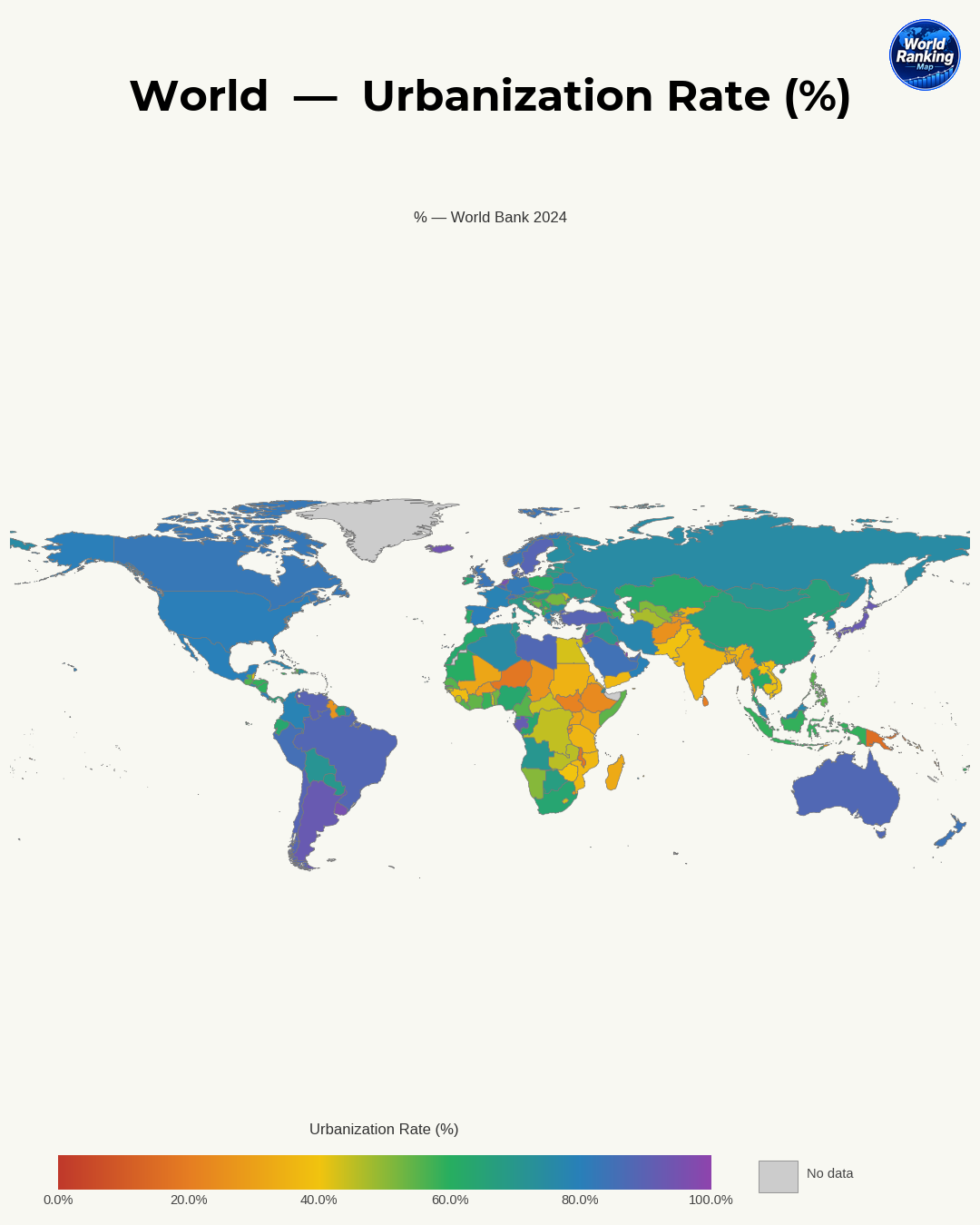
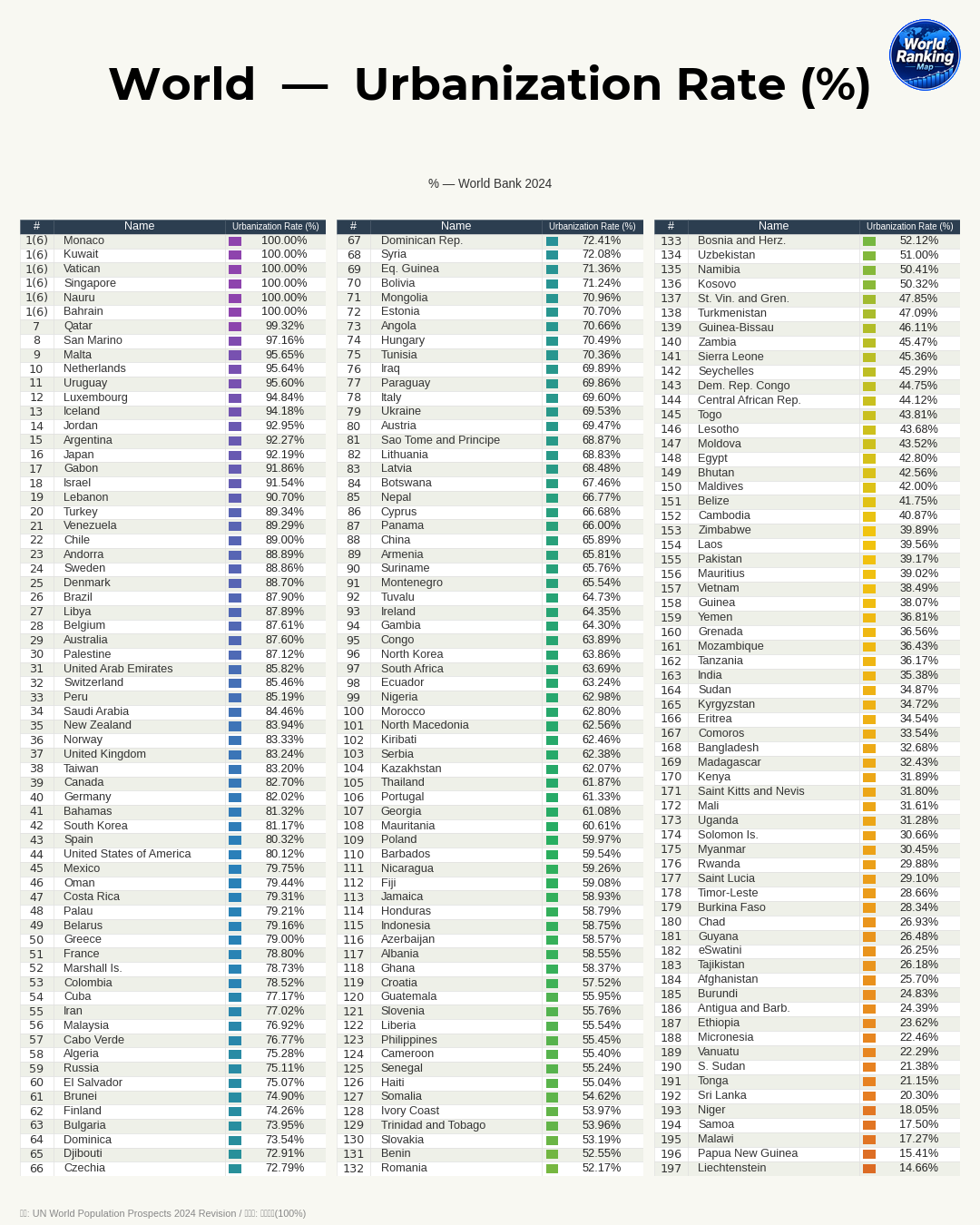
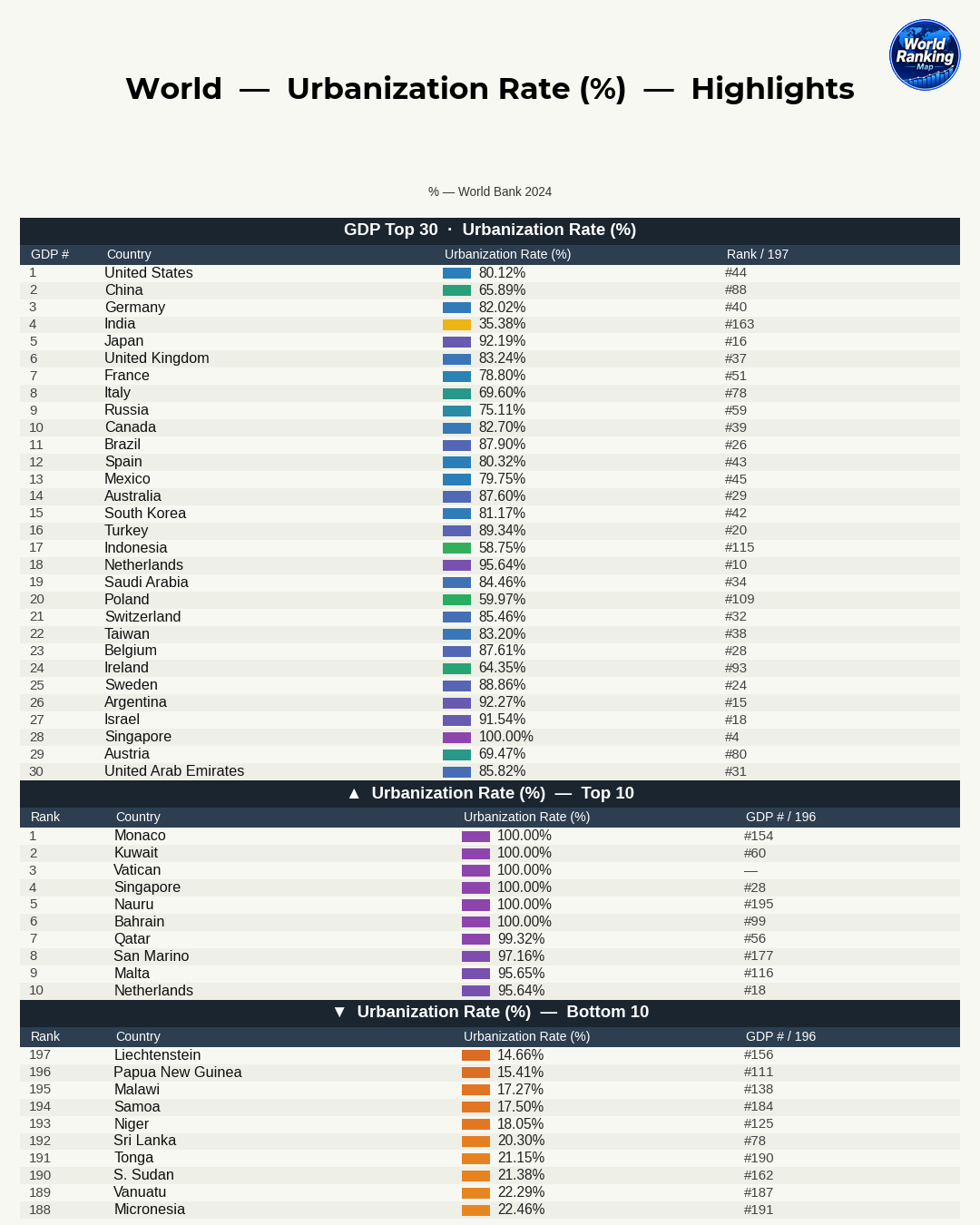
Comparing urbanization patterns across continents reveals several clear differences. Europe, North America, South America, and Oceania generally have high urbanization rates, while Asia and Africa may be at relatively low or middle levels on average, but are far more dynamic in terms of the speed and scale of urban population growth. Asia is especially characterized by large-scale industrialization and the spread of megacities, while Africa stands out for rapid urbanization amid high population growth and infrastructure shortages.
There are also clear commonalities. In almost every continent, cities are centers of jobs, education, healthcare, culture, and transportation, and they attract people and capital. At the same time, as urbanization deepens, the burden of housing, energy, water, transportation, and environmental management also grows. Urbanization is therefore both an opportunity for growth and a challenge to manage.
The outlook ahead depends on sustainable urban growth.
- Land-use planning that reduces unplanned urban sprawl
- Affordable and stable housing supply
- Expansion of public transportation and green infrastructure
- More efficient water, energy, and waste management
- Urban design resilient to climate change and disasters
- Improvement of informal settlements and greater social inclusion
Ultimately, the urbanization rate is more than a simple demographic statistic; it is an important window into each continent’s stage of economic development, social structure, and policy capacity. Urbanization around the world will continue, but true competitiveness will be determined not by how many people live in cities, but by how livable and sustainable those cities are.