The Differences in Consumer Culture Revealed by Global Coffee Consumption Rankings
Introduction: Coffee and the World
Coffee is one of the most globalized consumer beverages today. From the morning espresso that starts the day, to the drip coffee people drink at work, to café culture for meeting friends, coffee has become more than just a drink—it is an indicator of lifestyle, the economy, and cultural trends. That is why looking at global coffee consumption rankings tells us not only which countries drink the most coffee, but also reveals a society’s climate, income level, degree of urbanization, dining-out culture, and even traditional eating habits.
Coffee consumption statistics are especially often interpreted from two perspectives. One is total consumption, which shows how much coffee a country consumes overall, and the other is per capita consumption, which shows how much the average person drinks. Even among countries that rank high in coffee consumption, these two measures can produce very different pictures, so to understand what the rankings really mean, we need to look at the background behind the numbers.
Characteristics of Top Consumer Countries
Countries that rank near the top in global coffee consumption often include large markets such as the United States, Brazil, Germany, Japan, France, and Italy. These countries share common traits: large populations, coffee deeply embedded in everyday life, or highly developed food and beverage industries.
The United States is a classic powerhouse in total consumption. It has a large population, a well-developed office culture and takeout culture, and a huge market for major coffee chains and convenience-store coffee. Coffee functions not just as a café beverage, but as a daily stimulant and a consumer good on the way to work. This structure drives total consumption sharply upward.
Brazil is an even more interesting case. It is both a major coffee producer and a huge consumer market. Because production and consumption coexist within the same country, coffee is highly accessible and competitively priced. In addition, coffee has long been part of the food culture, so it is consumed naturally at home and at work.
Top European consumers show another pattern. Germany, France, Italy, the Netherlands, and the Nordic countries have long treated coffee as part of meals, breaks, and socializing. In particular, Italy’s espresso culture, France’s café culture, and the everyday filter coffee consumption of Germany and the Nordic region each create high consumption in different ways.
The common factors among top consumer countries can be summarized as follows:
- High levels of urbanization: café, office, and on-the-go consumption are active.
- High income levels: people have more room in their budgets for dining out and consumer beverages.
- Coffee culture is normalized: it is not a special drink, but a habitual purchase.
- Well-developed distribution networks: there are many options, including beans, capsules, RTD coffee, and chain cafés.
- Climate and lifestyle rhythms matter: colder regions also tend to show stronger demand for warm beverages.
That said, a high ranking does not necessarily mean a country “loves coffee the most.” In some countries, the total is large simply because the population is large; in others, per-person consumption is extremely high despite a smaller population.
Per Capita vs. Total Consumption
The most important distinction when interpreting global coffee consumption rankings is that total consumption and per capita consumption tell different stories.
Total consumption rankings show market size. By this measure, countries with large populations and large economies—such as the United States, Brazil, and Japan—have an advantage. For food and beverage companies, chains, and coffee importers, countries with high total consumption may be the more important markets. In other words, total consumption is well suited to understanding industrial value and market size.
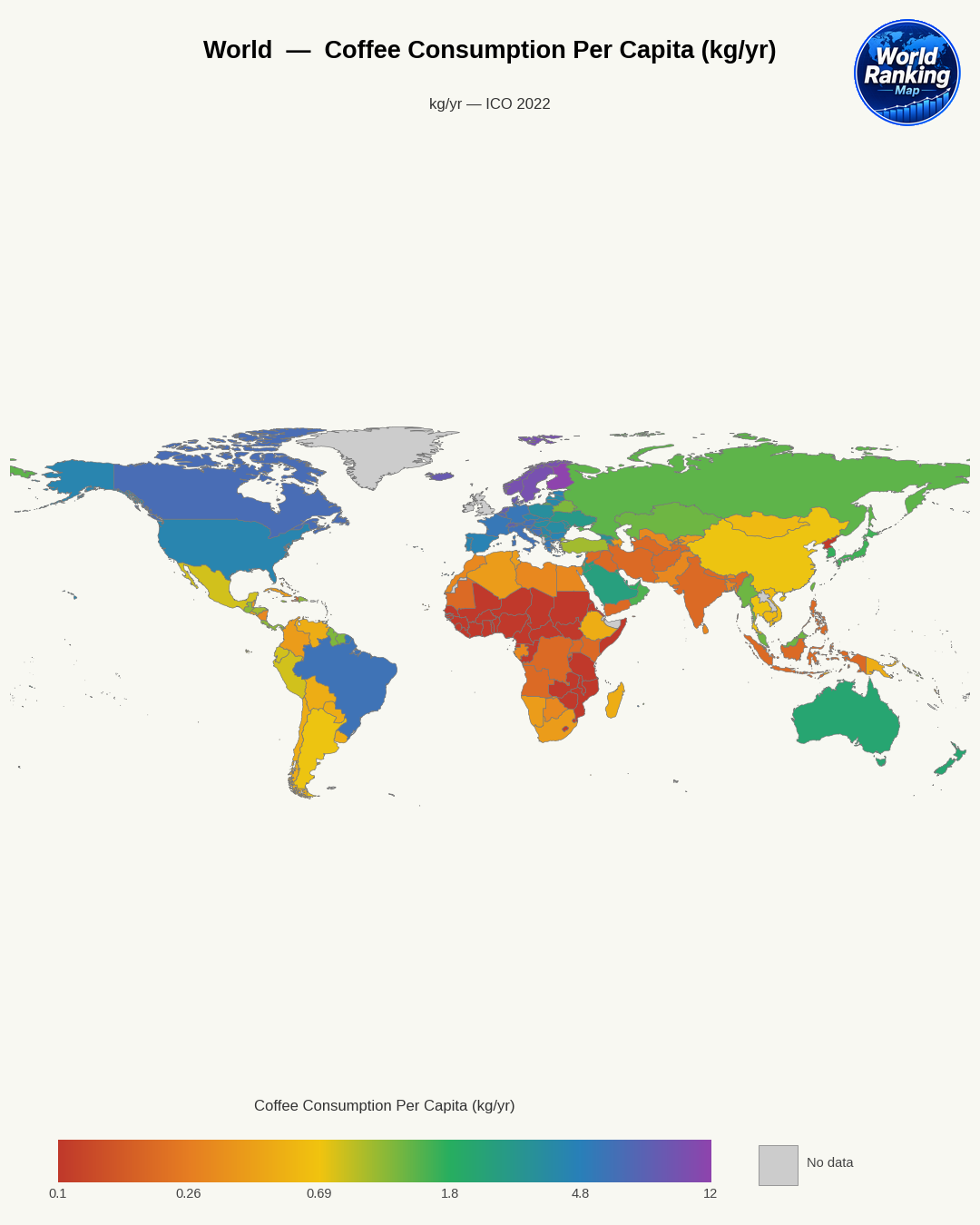
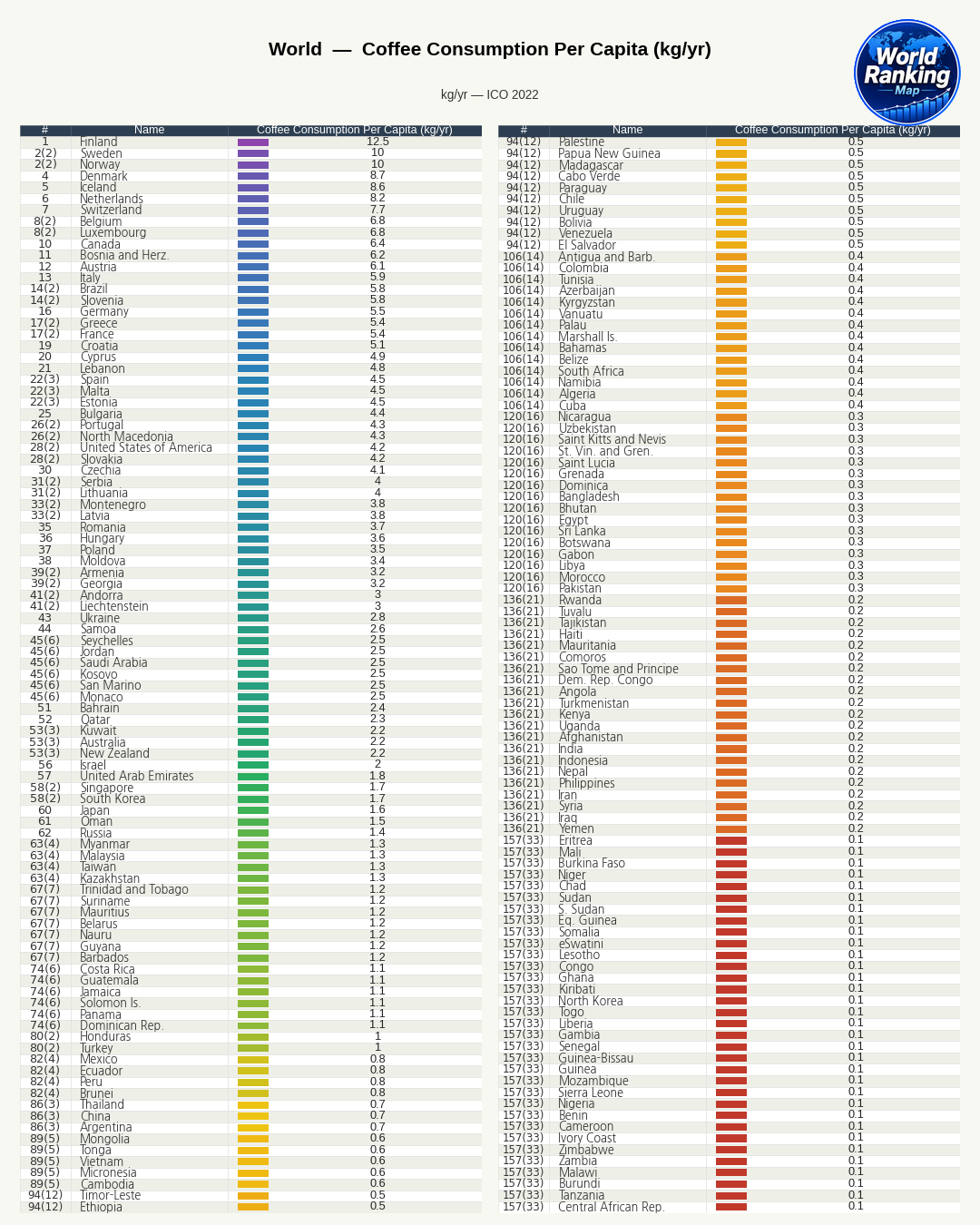
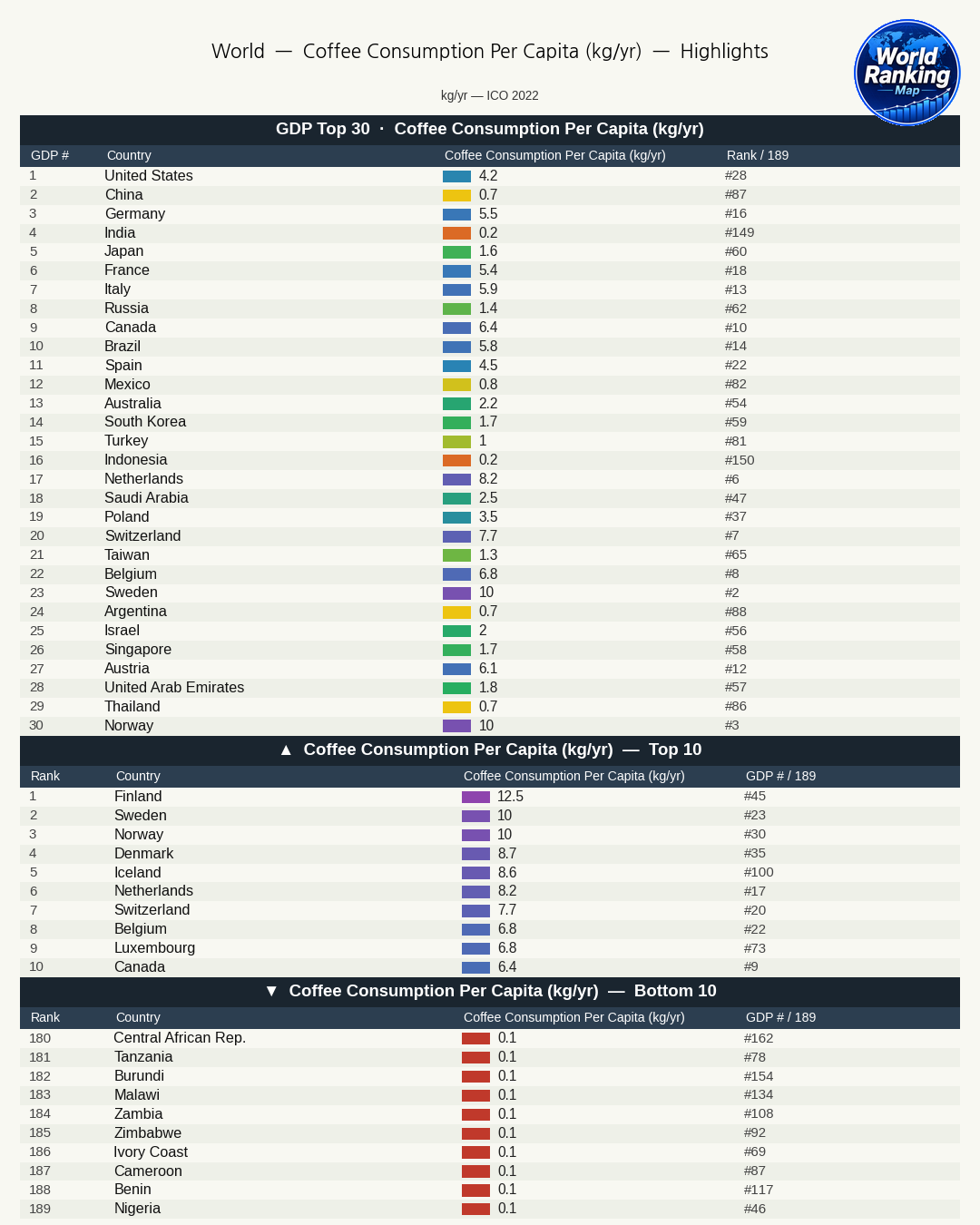
By contrast, per capita rankings often place countries such as Finland, Norway, Iceland, Denmark, and the Netherlands near the top. These countries do not have large populations, but each person drinks coffee very frequently. The Nordic region in particular is well known for high per capita consumption, driven by a cold climate, indoor-oriented lifestyles, and a long-standing coffee break culture.
This difference has important implications for how rankings should be read.
- Countries with high total consumption: large consumer markets, strong distribution networks, and mass consumption patterns.
- Countries with high per capita consumption: coffee has become a deeply rooted cultural habit.
- Countries high on both measures: exceptionally strong coffee countries with both market scale and cultural familiarity.
For example, Japan is a very important country in terms of total consumption, but it may rank lower than Nordic countries in per capita terms. This means that while Japan has a large population and a highly developed market for canned coffee, convenience-store coffee, and cafés, its average individual consumption may still fall short of traditional coffee powerhouses.
Conversely, Finland is a small country by global population standards, but it is consistently mentioned among the top countries in per capita consumption. This shows that coffee there is not just a trend, but a daily and repeated habit.
So when looking at coffee consumption rankings, asking only “Which country drinks more?” is not enough. More accurate questions are:
- Which country has the largest overall market?
- Which country’s people drink coffee most frequently?
- Is consumption driven more by culture or by commerce?
- Is home consumption large, or is café and dining-out consumption larger?
In this way, the same coffee consumption statistics can be interpreted very differently depending on the perspective.
Conclusion
Global coffee consumption rankings are not just tables comparing beverage intake. They are fascinating social indicators that reveal lifestyle, economic scale, climate, culture, and industrial structure all at once. Countries with high total consumption usually have large markets and well-developed distribution systems, while countries with high per capita consumption often have coffee more deeply embedded in everyday life.
In the end, what the rankings reveal is not the numbers themselves, but the background that produced them. In some countries, high consumption comes from takeout coffee on the way to work; in others, from filter coffee at home; and in still others, from a long-standing café tradition. The same coffee is consumed differently from country to country, and that difference is what makes the world coffee map so interesting.
The best way to read coffee consumption rankings is not to stop at identifying the number-one country, but to also consider how those rankings reflect each country’s society and culture. Seen that way, a cup of coffee becomes not just a consumer beverage, but another window into understanding the world.